Public Safety Is on the Ballot. So Is Accountability.
Campaign season has a way of making promises sound like accomplishments. A candidate says the right words about safe streets, lower costs, and responsible government. The signs go up. The advertisements run. The question that matters most is often left unanswered: What will actually change for the people who live and work here?
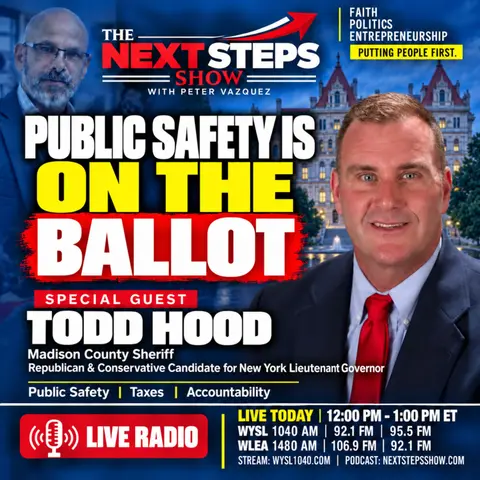
On the October 29, 2026 edition of The Next Steps Show, Bob Savage and I examined that question with two New York candidates. Madison County Sheriff Todd Hood, the Republican and Conservative candidate for lieutenant governor running alongside Bruce Blakeman, joined us to discuss public safety, state policy, and government accountability. We also spoke with Mercedes Vazquez-Simmons, a Monroe County legislator seeking the State Assembly seat in District 137 on the independent Mercedes Simmons Cares ballot line. The conversations approached different offices and concerns, but they led back to a common standard: Public service must be judged by results.
Public Safety Is a Responsibility, Not a Campaign Phrase
Hood brought his law-enforcement perspective to our discussion of bail reform, juvenile crime, and the staffing pressures facing corrections. Those issues are not abstractions to a victim, a parent worried about a child walking home, a corrections officer working a difficult shift, or a young person trying to avoid a life defined by one bad decision.
There are genuine disagreements about how the law should balance public protection, rehabilitation, pretrial fairness, and constitutional rights. Those differences deserve a hearing. But there is no reason to lower the standard of proof simply because an argument comes from a candidate whose politics we share.
When a public official proposes a change to bail or juvenile justice, the public should ask what the policy is intended to accomplish, how it will be implemented, and how success will be measured. Will it reduce repeat offenses? Will it improve safety for victims and neighborhoods? Will it respect due process? Can the agencies tasked with carrying it out actually do the job?
A government that demands trust must be prepared to demonstrate competence. The badge, the title, and the campaign slogan do not relieve anyone of that obligation.
Affordability Has a Human Cost
Our conversation with Hood also turned to New York taxes, government spending, and proposed income-tax relief. Those were campaign positions and proposals discussed on air, not independently established results. The proper test is whether the numbers, the funding, and the likely consequences withstand scrutiny.
Vazquez-Simmons addressed affordability from the neighborhood level, including utility bills and the concerns she hears from residents. That perspective matters too. A family trying to cover the electric bill is not interested in an accounting exercise designed to make Albany look successful. A small-business owner deciding whether to expand needs more than another speech about opportunity.
Tax relief, spending reductions, and government programs all involve choices. What would a proposal cost? What would it save? Who benefits, who bears the burden, and which services would be affected? Those questions should apply to every candidate, regardless of party or ballot line.
It is easy to promise that government will do more while taxpayers pay less. It is harder to show the budget, explain the tradeoffs, and accept responsibility when projections fail. That is the harder work voters should demand.
The Public Deserves a Real Conversation
Listener calls brought the discussion back to voting, constitutional rights, and the choices New Yorkers face. That is a valuable reminder of why we open the microphone. A radio program should not become an applause line for people who already agree. It should be a place where a claim can be questioned, an opposing view can be heard, and the public can make a better-informed judgment.
Respecting the Second Amendment, protecting public safety, and insisting on lawful government are serious responsibilities. So is allowing disagreement without treating every person across the aisle as an enemy. We lose something important when political identity becomes a substitute for examining evidence.
An Internet Full of Information Still Requires Discernment
We closed the October 29 broadcast by recognizing National Internet Day and considering what nearly six decades of digital communication have changed. The internet makes government documents, candidate statements, reporting, and competing opinions easier to find. It also makes unsupported accusations and selective clips easier to circulate.
Access to more information does not automatically produce better judgment. Before sharing a political claim, we should ask where it came from, when it was made, what the original source actually says, and what essential context might be missing. Technology is a useful servant. It is a poor substitute for independent thought.
Six Questions Worth Asking Any Candidate
- What specific problem are you trying to solve? Describe it with evidence rather than a slogan.
- What exactly would you change? Name the policy, law, spending decision, or administrative practice.
- What would it cost? Explain the funding source and the tradeoffs.
- Whose rights and responsibilities are affected? Account for public safety, due process, and constitutional limits.
- How would we know it worked? Commit to measurable outcomes, not just announcements.
- Will you answer for the result? Accountability must continue long after the campaign ends.
Whether the subject is crime, taxes, utility bills, education, or the future of a neighborhood, these questions give citizens a stronger foundation for evaluating leadership. They also remind candidates of something essential: The public office belongs to the people, not to the person seeking it.
Listen to the full October 29 broadcast: Todd Hood: Public Safety Is on the Ballot. The episode includes our conversations with Todd Hood and Mercedes Vazquez-Simmons, listener calls, and the National Internet Day reflection.
The Next Steps Show with Peter Vazquez airs weekdays from noon to 1 p.m. Eastern on WYSL and WLEA. Putting People First.
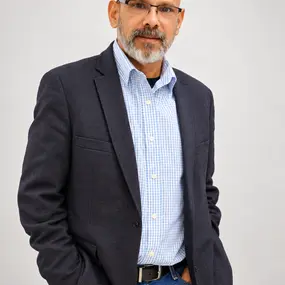
Host & Producer, The Next Steps Show
Peter Vazquez is the host and producer of The Next Steps Show, airing live weekdays on WYSL and WLEA. Born and raised in Rochester, New York, he brings experience as a U.S. Army veteran, business owner, and former nonprofit executive to conversations about faith, politics, entrepreneurship, and everyday life.
Peter's approach is grounded in direct questions, careful attention to the public record, and a belief that decisions must be judged by their results. He welcomes elected officials, community leaders, authors, entrepreneurs, and voices with differing perspectives. The show's guiding mission is simple: Putting People First.
Listen live weekdays from noon to 1:00 p.m. Eastern or explore full episodes, video conversations, guest profiles, and original commentary at NextStepsShow.com.
Ballot Delays and the Burden of Public Trust