


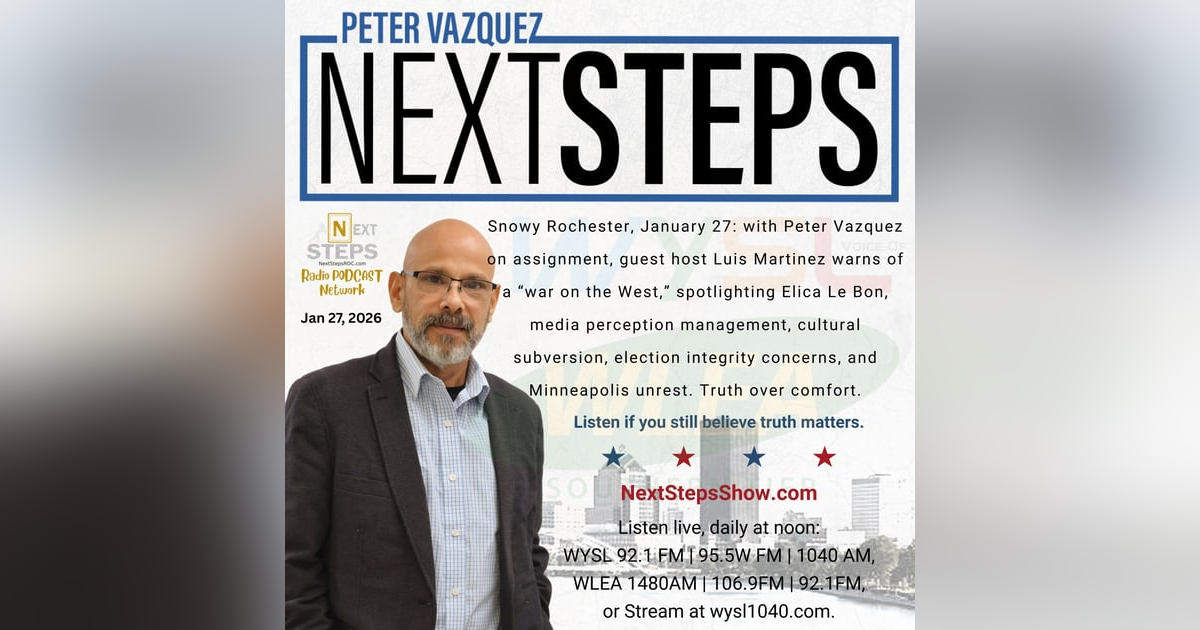

War on the West is a cold-weather warning from Rochester: Luis Martinez, filling in for Peter Vazquez, spotlights Elica Le Bon’s framing of media-managed reality, Islamist tyranny, and a culture pressured by propaganda. Calls on election integrity, public order, and citizen journalism drive one conclusion: choose truth, vote, and defend the foundations that built the West.


Snow fell hard in Rochester, the kind of cold that makes you respect gravity and good boots. With Peter Vazquez on assignment, Luis Martinez stepped into the studio and turned a January 27 broadcast into a warning bell, ringing in two languages and one clear message: the West is being tested, and truth is being rationed.
He dedicated the hour to Iranian American dissident Elica Le Bon, borrowing her framing of a “war on the West,” where legacy media does not merely miss stories, it curates reality. The target is not a party, but a civilization: reason over myth, the rule of law over rulers, individual dignity under God, and the free-market engine that built more prosperity than any planner ever did.
Luis traced the old fight from communist regimes to Islamist tyrannies, and then to the strange modern alliance of ideological extremes that thrive on grievance and confusion. He argued that propaganda works by inversion: the West is recast as the villain, and jihadists are polished into “oppressed freedom fighters,” while Iran’s brutality fades off the screen.
Then the phones lit up. A caller raised allegations about election integrity and machine vulnerabilities; Luis countered with on-the-ground concerns about New York’s registration safeguards, and the need for citizens to verify, document, and vote. Minneapolis surfaced as a symbol of institutional rot and online claims of deep corruption, alongside a reluctant truth: independent journalists now break what corporate media buries.
The station celebrated 150,000 podcast downloads. A reminder that people still want unfiltered reality. Offensive truth hurts. Comfortable lies rot. Choose wisely.
Promote your brand on the Next Steps Show, airing on WYSL1040.com's AM 1040, FM 92.1, and FM 95.5 West stations. Discover more at nextstepsroc.com/advertise-with-us or dial (585) 346-3000 to get in touch with the WYSL team.
Have you ever dreamt of sharing your unique voice, stories, or expertise with the world through a podcast? Perhaps you're bubbling with ideas but uncertain about where to begin? The journey from idea to launch can be daunting, but that's where we come in. Dive Into the World of Podcasting with Next Steps Radio PODCAST Network! Visit NextStepsRoc.com or call Peter at (585) 880-7580.

Episode Transcript: War on the West
Media, Power, and Perception
With Peter Vazquez on assignment, Luis Martinez guest-hosts a discussion centered on culture, media, and the future of Western civilization. Broadcasting from Rochester during severe winter conditions, Martinez opens by dedicating the program to Iranian-American freedom advocate Elica Le Bon, whose work frames the conversation.
Le Bon’s central claim is that mainstream media does not simply overlook events such as Iranian uprisings, but deliberately suppresses them. Martinez explains that exposing the reality of Islamist regimes would unravel a carefully maintained narrative portraying the West as the primary source of global injustice.
Defining Western Civilization
Martinez outlines what he means by “the West,” grounding it in historical and philosophical foundations. He describes Western civilization as rooted in rationalism, evidence, and the scientific method; individual dignity and responsibility before God; the rule of law; representative government; and Judeo-Christian moral traditions such as conscience, charity, and human worth.
He emphasizes that free-market capitalism and innovation are inseparable from these values, arguing that they have produced the most prosperous and fair societies in human history.
Ideological Warfare and Modern Alliances
The discussion traces ideological hostility toward the West from twentieth-century communism to modern Islamist movements. Martinez argues that while communism never disappeared, Islamist regimes have assumed a leading role in opposing Western norms.
He further asserts that this external pressure is reinforced internally by political and cultural movements within Western nations. According to Martinez, extremes on both the left and fringe right now employ similar tactics—tribalism, grievance politics, and historical revisionism—creating a multi-front assault on shared civilizational principles.
The Role of Legacy Media
Martinez sharply critiques corporate media institutions, arguing that they function as perception managers rather than truth tellers. He claims that major outlets routinely omit or distort stories involving Iran, immigration enforcement, and crime in order to sustain a narrative that casts Western institutions as oppressive and their adversaries as victims.
He warns listeners not to underestimate propaganda, noting that history repeatedly shows how sustained falsehoods can reshape public belief.
Elections, Accountability, and Civic Trust
Drawing on his experience as a certified poll inspector in New York State, Martinez raises concerns about election integrity and voter registration safeguards. He discusses state-level policies that he believes weaken verification processes and reduce transparency, arguing that public trust requires clear accountability.
A caller expands the discussion by alleging vulnerabilities in electronic voting systems and centralized election technology. Martinez reinforces the need for citizens to remain vigilant, informed, and engaged beyond official narratives.
Minneapolis, Independent Media, and Exposure
The conversation turns to Minneapolis as an example of institutional failure, ideological governance, and alleged corruption. Martinez and callers highlight the growing importance of independent journalists, alternative media, and digital platforms in exposing stories overlooked or ignored by legacy outlets.
The role of online platforms and decentralized reporting is presented as a critical counterbalance to concentrated media power.
Closing: Truth, Responsibility, and Renewal
Martinez concludes with cautious optimism. He references commentary suggesting that many people across Western nations still hold to faith, family, national identity, hard work, and personal responsibility. He argues these values remain resilient beneath political noise and manufactured division.
He closes with a warning and a call to action: truth may offend, but lies corrode. The preservation of Western civilization, he argues, depends on citizens choosing truth, voting, speaking, and refusing to surrender their culture to deception.

Management Consultant
Luis Martinez has coached and advised professionals for many years, helping leaders strengthen performance, communication, and decision-making under pressure. He has held senior-level assignments at Xerox, Lehigh Valley Hospital, Exide Technologies, and The Hay Group, bringing experience across corporate, healthcare, and consulting environments.
Luis earned a B.A. in Psychology and an M.Ed. in Counseling from the University of Delaware. He also holds two respected professional credentials: Senior Professional in Human Resources (SPHR) and Certified Compensation Professional (CCP), reflecting a career grounded in both people development and organizational discipline.
Born and raised in Cuba, Luis watched his parents, Jose Luis and Zoila, navigate crises with steadiness, faith, and personal responsibility. He credits their example for shaping his optimism and resilience, and for reinforcing a simple conviction that still guides his work: truth matters, character matters, and solutions are built through accountability and courage.