


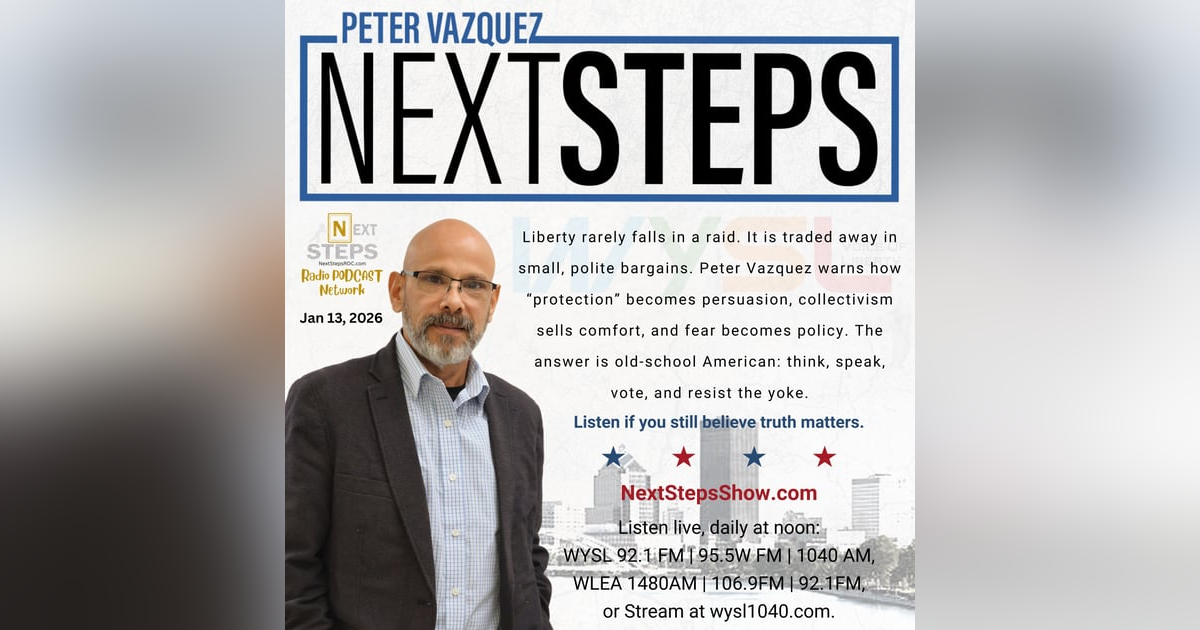

Protection Becomes Persuasion explores how freedom is rarely taken by force but surrendered through comfort, fear, and compliance. Peter Vazquez traces the cultural shift from responsibility to dependency, exposing collectivism, media narratives, weakened elections, and soft governance that reframes control as compassion. Liberty survives only where citizens think, speak, vote, and refuse the quiet trade of freedom for ease.


Liberty is not stolen in one raid, it is traded away in small, polite bargains. Peter Vazquez warns how “protection” becomes persuasion, how collectivism sells comfort and bills you later. Callers sharpen the fight: media, broken elections, and fear as policy. The cure is old-school American: think, speak, vote, and refuse the yoke.
Promote your brand on the Next Steps Show, airing on WYSL1040.com's AM 1040, FM 92.1, and FM 95.5 West stations. Discover more at nextstepsroc.com/advertise-with-us or dial (585) 346-3000 to get in touch with the WYSL team.
Have you ever dreamt of sharing your unique voice, stories, or expertise with the world through a podcast? Perhaps you're bubbling with ideas but uncertain about where to begin? The journey from idea to launch can be daunting, but that's where we come in. Dive Into the World of Podcasting with Next Steps Radio PODCAST Network! Visit NextStepsRoc.com or call Peter at (585) 880-7580.

Peter Vazquez opens with a warning: liberty is not usually taken by force, but surrendered through persuasion. Protection, he argues, is increasingly framed as obedience, and responsibility is traded for comfort. This dynamic, which he describes as a cultural crisis of persuasion, reshapes how citizens relate to authority.
He grounds the discussion in first principles: liberty precedes government, not the reverse. The role of the state is to protect rights, not redefine them. Compassion divorced from responsibility corrodes both freedom and culture.
Vazquez critiques collectivism as a political and moral framework, warning that it dissolves personal agency and subordinates individuals to the group. Drawing comparisons to Venezuela, Iran, and other authoritarian systems, he argues that collectivist ideology consistently erodes women’s freedom, parental authority, and religious liberty.
Callers expand the discussion, pointing to corporate media narratives, election integrity failures, and cultural institutions that suppress dissent. The media is described as a primary force shaping public compliance by redefining truth and marginalizing opposition.
The conversation turns to elections as moral boundaries of a nation. Vazquez argues that while borders define a country physically, elections define it morally. Trust in governance requires verification, and stewardship of elections is not suppression.
Mental health trends are examined in the context of cultural confusion, loss of agency, and declining civic participation. Vazquez rejects dehumanization but challenges the systems that manufacture despair by undermining family, faith, and responsibility.
The discussion broadens to free speech, religious liberty, and institutional obedience. Vazquez questions whether obedience to authority remains virtuous when authority itself abandons constitutional limits. Examples from the military, education, and state policy illustrate the cost of silence.
Proposed legislation and executive actions in New York and California are cited as evidence of a growing effort to criminalize dissent and blur the line between ideological disagreement and criminal conduct.
The program concludes with a call to discernment and action. Liberty requires participation. Truth requires friction. Authority must always be questioned by those who consent to be governed.
Vazquez closes by urging listeners to lead, speak, vote, and refuse the quiet trade of freedom for comfort.
End of cleaned transcript.