


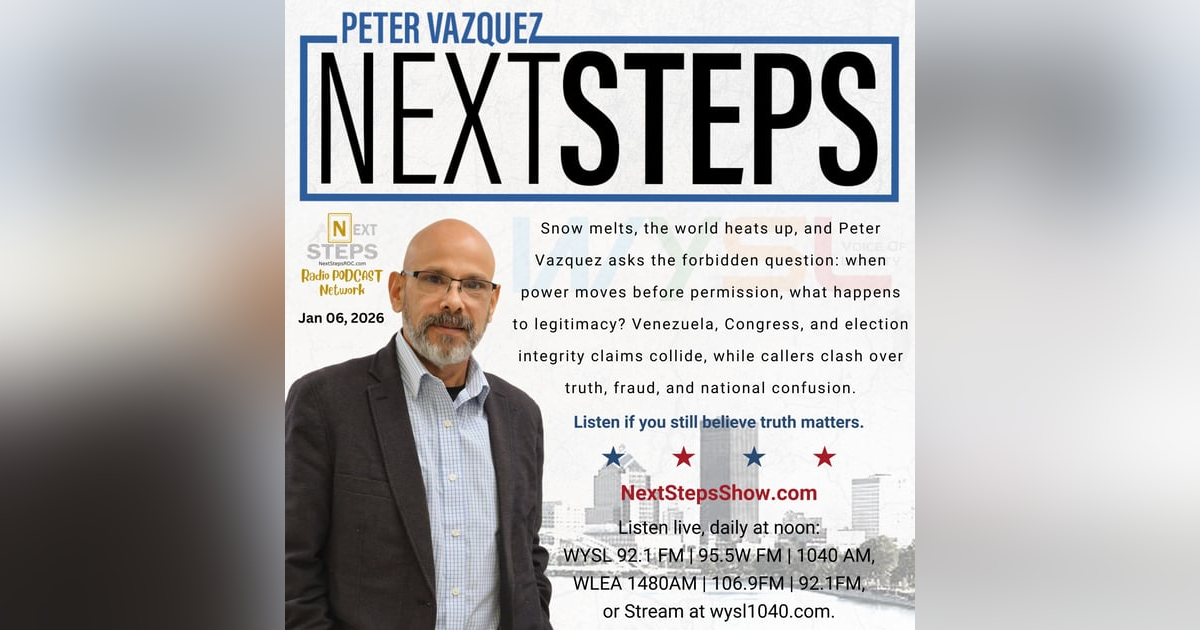

Power Before Permission explores what happens when force precedes consent. From Venezuela to Washington, constitutional authority, election integrity claims, and media narratives collide. Callers debate law enforcement versus war, fraud versus oversight, and the quiet expansion of power. In an age of confusion, discernment, verification, and responsibility remain the last defenses of liberty.


Snow melts, the world heats up, and Peter Vazquez asks the forbidden question: when power moves with force before permission, what happens to legitimacy. Venezuela becomes the test case, Congress becomes the footnote, and callers clash over war, law enforcement, and election integrity claims tied to Smartmatic. Then the lens widens to fraud, identity shields, and the discipline of poetry as a cure for national confusion.
Promote your brand on the Next Steps Show, airing on WYSL1040.com's AM 1040, FM 92.1, and FM 95.5 West stations. Discover more at nextstepsroc.com/advertise-with-us or dial (585) 346-3000 to get in touch with the WYSL team.
Have you ever dreamt of sharing your unique voice, stories, or expertise with the world through a podcast? Perhaps you're bubbling with ideas but uncertain about where to begin? The journey from idea to launch can be daunting, but that's where we come in. Dive Into the World of Podcasting with Next Steps Radio PODCAST Network! Visit NextStepsRoc.com or call Peter at (585) 880-7580.

The Next Steps Show Cleaned Transcript
Host: Peter Vazquez
Opening Monologue
In a world that changes daily, the central question remains: where are you standing, and what will you do next? This program exists to slow things down long enough to think clearly. Faith, country, and family are not slogans. They are complex systems no computer could ever fully model, and they deserve careful stewardship.
Peter Vazquez opens the lines to listeners, emphasizing that dialogue matters more than guests alone. A free society depends on neighbors speaking, questioning, and being heard.
Power, Permission, and Constitutional Authority
The discussion turns to recent events in Venezuela following the capture of President Nicolás Maduro and his wife in what was described as a U.S. law enforcement operation. Peter raises a core constitutional concern: when the government moves with force before permission, legitimacy is already in trouble.
He challenges the language used by political leadership, particularly claims that the United States is now “in charge” of Venezuela. In plain constitutional terms, Peter asks what that actually means. Article I grants Congress the power to declare war. Article II gives the President command authority after authorization. There is no clause allowing unilateral control of another sovereign nation based on moral certainty.
History is cited. The United States has conducted over 125 military interventions but has formally declared war only eleven times. This gap, Peter argues, is not accidental. It is how power expands quietly, through language that blurs war, enforcement, and occupation.
Venezuela, Narrative Control, and Discernment
Peter acknowledges the complexity of the situation and admits the limits of public information. He plays devil’s advocate, noting that while the operation was framed as law enforcement, the visuals and outcomes resemble military action. He warns that when optics replace constitutional clarity, decision making deteriorates into emotional politics.
The concept of “vamboozleness” is introduced as the condition where repetition replaces truth and confusion becomes policy. Citizens are told to trust authority while being discouraged from verifying it.
Callers and Election Integrity Claims
Caller Gary Stout joins the discussion, presenting claims that the Venezuela operation was tied to dismantling transnational criminal networks connected to election software, including Smartmatic. He references whistleblower investigations, alleged cartel involvement, and long-running money laundering operations.
Gary argues that the takedown was strategic, aimed at disrupting criminal infrastructure rather than declaring war. He urges listeners to research interviews with Gary Berntsen and Ralph Pizzullo for deeper context.
Another caller, Keith, adds historical context, comparing the situation to the U.S. removal of Manuel Noriega in Panama. He argues that the operation did not decapitate the Venezuelan government or destroy infrastructure, framing it as targeted enforcement.
Peter responds by returning to optics versus clarity, warning that public perception matters, especially heading into midterm elections. Even justified actions can be misinterpreted when communication fails.
Boundaries of Rhetoric
During a heated call, Peter firmly redirects the conversation after extreme rhetoric is expressed. He reinforces that disagreement must remain grounded in law, reason, and moral restraint. True liberty depends on discipline, not rage.
Poetry, Literacy, and Cultural Decline
Marking National Take a Poet to Lunch Day, Peter reflects on poetry as a discipline that sharpens language, emotional intelligence, and abstract reasoning. Declining literacy, he argues, contributes directly to political confusion and manipulation. Words matter. Precision matters.
Fraud, Oversight, and Institutional Failure
The conversation broadens to include large-scale fraud cases in Minnesota and New York. Peter questions why oversight only appears after viral confrontations rather than proactive leadership. One-party control, he argues, breeds complacency regardless of ideology.
He criticizes identity-based deflections that replace invoice verification and accountability. Oversight is not oppression. It is stewardship.
Election Systems and Global Networks
Gary Stout returns briefly to outline claims regarding election machine vulnerabilities, foreign server access, and long-term manipulation capabilities. Peter notes the seriousness of the allegations while urging listeners to research independently and critically.
Closing Reflections
Peter closes by urging listeners to trust but verify. Power unchecked by permission corrodes legitimacy. Whether discussing foreign policy, elections, fraud, or culture, the solution is the same: disciplined thinking, moral clarity, and active citizenship.
Do not surrender your discernment. Be a leader. Be a voice for liberty.
End of Transcript