

 iHeartRadio

 Apple Podcasts

 Spotify

 TuneIn

 Podchaser

 Castro

 Amazon Music

 PlayerFM

 RSS Feed
Nicholas Fondacaro: The Truth Omitted, the Price Paid
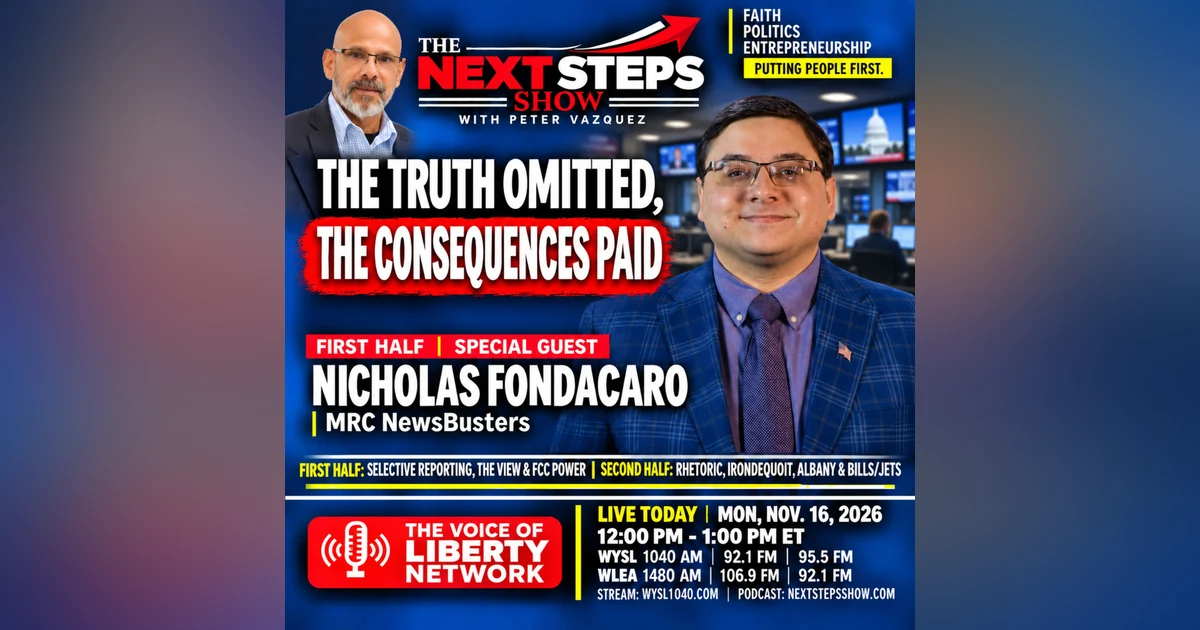

Nicholas Fondacaro of MRC NewsBusters joins Peter Vazquez and Bob Savage to examine news reporting by omission, coverage of the Ma'Khia Bryant case, political messaging on The View, immigration language, the First Amendment, and the Fairness Doctrine.
Key Takeaways
- Nicholas Fondacaro argues that omitted emergency-call audio and body-camera context in coverage of the 2021 Ma'Khia Bryant shooting can change how audiences understand a news story.
- Peter Vazquez, Bob Savage, and Fondacaro examine reporting by omission, public trust in journalism, and the temptation to believe only news sources that reinforce existing views.
- An exchange between Arkansas Governor Sarah Huckabee Sanders and Sunny Hostin on The View sparks debate about immigration terminology, political messaging, and the meaning of words.
- The hosts discuss controversial remarks featured in MRC's Worst Media Quote of the Week, distinguishing constitutionally protected expression from moral approval of cruel rhetoric.
- Caller Lorraine's questions about the FCC lead to a discussion of the Fairness Doctrine, free speech, and the risks of government control over controversial broadcasting.
- The broadcast closes with a conversation about information overload, the 'tyranny of choice,' and the responsibility of Americans to examine competing claims carefully.
Today, Nicholas Fondacaro, Associate Editor of MRC NewsBusters, joins Peter Vazquez and Bob Savage to ask whether a news report can contain technically accurate details yet mislead audiences through what it omits. Fondacaro revisits network coverage of the 2021 Ma'Khia Bryant police shooting in Columbus, Ohio, comparing the emergency-call and body-camera context that NBC, ABC and CBS presented. They discuss editorial judgment, media trust and why missing context can change how a story is understood.
The interview turns to political messaging on ABC's The View. A recording of Arkansas Governor Sarah Huckabee Sanders debating immigration terminology with co-host Sunny Hostin leads to questions about language, selective reporting and the boundary between journalism and political commentary. Fondacaro also explains his NewsBusters analysis of the program's guest lineup.
In the second half, Peter and Bob examine controversial remarks featured in MRC's Worst Media Quote of the Week and the difference between protecting speech and endorsing cruel rhetoric. Caller Lorraine asks whether the FCC can address misleading broadcast coverage. Their exchange revisits the Fairness Doctrine, First Amendment protections and the danger of giving government authority to decide which views may be heard.
The program closes by considering information overload, the abundance of modern media choices and accounts of immigrants who left Soviet-bloc countries for the freedoms of American society. With more access to information than ever, what responsibility do citizens have to seek the full story?
Original broadcast: November 16, 2026, at 1:00 PM EST (America/New_York). The Next Steps Show with Peter Vazquez on WYSL/WLEA, Voice of Liberty Network. Putting People First.
Keep the conversation going: More episodes · Watch videos · Read commentary · Send a voice message. Live weekdays at noon Eastern on WYSL and WLEA.
Advertising and sponsorship opportunities.
Frequently Asked Questions
Who is Nicholas Fondacaro, and what does he discuss on Episode 743?
Nicholas Fondacaro is Associate Editor of MRC NewsBusters. He joins Peter Vazquez and Bob Savage to discuss how selective reporting, missing context, political messaging, and media bias can influence public understanding of the news.
What does media bias by omission mean?
Bias by omission occurs when reporting leaves out relevant information that could materially change how an audience understands an event. Fondacaro illustrates the concern by comparing televised coverage of the 2021 Ma'Khia Bryant police shooting in Columbus, Ohio.
Why does the episode discuss Sarah Huckabee Sanders and Sunny Hostin on The View?
The hosts play an exchange between Arkansas Governor Sarah Huckabee Sanders and The View co-host Sunny Hostin about immigration terminology. They use it to discuss word choice, political framing, and the distinction between journalistic reporting and advocacy.
What does Episode 743 say about the First Amendment and offensive speech?
Peter and Bob discuss controversial remarks featured in MRC's Worst Media Quote of the Week. They distinguish the legal protection of offensive speech from a personal or moral endorsement of what someone says.
Why does a caller bring up the FCC and the Fairness Doctrine?
Caller Lorraine asks whether the FCC can address misleading or unbalanced broadcasting. Peter and Bob revisit the Fairness Doctrine and debate whether government efforts to regulate political viewpoints could discourage open discussion or threaten free expression.
What is the 'tyranny of choice' discussed near the end of the broadcast?
The hosts use 'tyranny of choice' to describe how an overwhelming number of media sources and competing messages can make it harder to evaluate information. They compare today's information environment with accounts of immigrants adjusting to the greater choices available in the United States.
Episode 743 Transcript: Nicholas Fondacaro, The Truth Omitted, the Price Paid
The Next Steps Show | November 16, 2026 | Peter Vazquez, Bob Savage, and guest Nicholas Fondacaro
Full broadcast transcript. Automatically transcribed and lightly corrected for spelling and readability. Timestamps are approximate. The audio recording remains the authoritative source for exact wording and speaker identification.
[00:00]
This podcast is brought to you by Open Door Mission, restoring hope in changing lives. Opendoormission.com.
[00:11]
Mira la izquierda, mira la derecha, ¿qué ves? In a world that seems to change daily, what will you do next? Welcome to the Next Steps Show with Peter Vazquez, a starting point for discussion and a bit of direction.
Yep, you know, let me ask you a question, see? Can every sentence in a news report be technically true? While the overall presentation, right, leaves the audience with a fundamentally misleading understanding of reality just based on the words that they use, see, you know, kinda like the truth, but not really. You know, to have this conversation, we've invited, see, Nicholas Fondacaro, Associate Editor of MRC NewsBusters. Nicholas, thank you for joining us.
Man, I'll tell you, I love the work that you guys do out there. So having you guys on is a bit of a pleasure, sir. Thank you. Thank you so much. So so so Nicholas, you know, let's get right into it. You know, I started this question, can can news reports can can anything that's being put out there through mainstream media or even non mainstream media, through those digital aggregators, through Facebook posts, I mean, could they be true, but yet still contain lying or misleading information?
Absolutely. One of the biggest things we watch over here is biased by omission, right? So we have all sorts of things that like we're we're covering here and s a lot of the stuff that we look to and see what they don't cover is is a big thing. Like for instance, lately one of the big stories we've been covering is there was an attempted hijacking of a United Airlines flight by an illegal immigrant.
The fact that the person was an illegal immigrant was something that was not mentioned in a lot of the broadcast news reports. So they mentioned the hijacking. They don't or they didn't note that this person was an illegal immigrant. And then once that status sort of came out, then they started weeding the story out slowly and then until they dropped it completely within just not too long after the story broke. And then the other part of that story that that is a new bit of information that they're not covering is basically that this person also sort of tried to take advantage
[02:21]
Allegedly try to take advantage of the asylum process by claiming they're transgender, which the person is not. Which the person you know, I'll tell you. And the thing is that didn't get quite a bit of coverage. I mean I watched the news pretty regularly and I think I may had saw a glimpse on it, which you'd think a hijacking especially by an illegal immigrant would be something that we want to share with Americans, especially when airlines were just grounded. And other things are being fly no flown thrown around.
A absolutely. But the fact that is they just don't want certain narratives being certain facts out there because they affect the narrative that they're trying to portray for the people. That it does you know, you did an investigation back in I think it was twenty twenty one, Ma'Khia Bryant who was fatally shot by a Columbus police officer, Nicholas Reardon, do you remember that interview or that investigation? Yeah, yes, I do. Basically NBC
So police officers got a call saying that there was somebody trying to stab people at a party or like outside of a house in Columbus, Ohio. The police showed up in the process of as they're getting out of the car, this Ma'Khia Bryant was the knife was like she was literally in the process of stabbing somebody. The knife was on its way down, the police shot her, killed her. And basically a lot of the media or NBC in particular, they when they talked about this case and reporter on it, they cut out segments of the nine one one call.
Where they where the person on the phone was saying there's somebody here with a knife trying to stab people. And then when they were showing the body camera footage, they didn't really focus on the part of the video showing what the officer saw, which was the knife up coming down and about to step into the person and the only time they really showed the knife was it on the ground. Meanwhile you had ABC and CBS sort of freeze the frame, highlight the knife, being like, Look, this she's in the process process of this and basically NBC was just
Sort of going with the same old anti top narrative of officers arrive on the scene and just shoot a black lady. And this is a pr this is something we've seen repeatedly with NBC in particular where they take the anti police side. There was even a case around the same time where NBC was going after the I believe it was a a couple of police officers and I believe it was Philly in the body camera footage they show the guy
[04:41]
Inches away attacking the officer with a knife and they're like, Can you believe he shot this guy? It's like, well, the officer is literally about to die. Yeah. Yeah, we see that quite a bit. We see it happening throughout the nation when it comes to ice where they put part of the story. Although tell me something, 'cause you know, the average person watching TV probably wouldn't know what you know, or at least what you saw. But but but for somebody watching it, or at least can you share what convinced you right off the bat, watching that news coverage, that something was off
And that that that missing information, I mean, really it it changed that meaning of the whole story like you described, but what convinced you? Well, the reason is is because we're watching or like at the time I was on our night shifts, so I was watching both ABC, CBS and NBC, their evening news coverage of the exact same event. And when you're watching all three of them one right back to back to back, you can see all the different things that a lot of times they do focus on the same little points, and then there are sometimes you'll notice like
This this outlet focused on this point. This outlets focus on another point. Or two focused on one. In this instance, I saw that both ABC and CBS h f like highlighted the knife. They they zoomed in on the knife. They highlighted it. You know, we're like they'll sort of gray out part of the image but keep like the focus on a small part another part of the image to show you like here, this is what we this is the important thing we want you to look at. And both ABC and CBS both froze
On the knife and they showed it in the person's hand in the process of the stabbing or the attempted stabbing. And both of them also played the audio of the nine one one call of like a frantic person saying, Please somebody come here. There they're there's somebody here trying to kill us with a knife. So basically the an NBC did not show that or share that part of the nine one one call. So they're not giving you the full idea of what an officer arriving on the scene is expecting to see. So if the officer is hearing
This nine one one dispatch saying, Hey, there's somebody there with a knife and they pull up on the scene and they see somebody immediately with a knife trying to stab somebody, they're like, Okay, this is the suspect. They're in the act of this. We need to we need to stop it right now, immediately. I mean, even CNN at the around that time too, they were basically sort of chiding NBC a little bit. They like, there was like a report of that they didn't even show the knife in the hand and there was like
[06:54]
Even CNN who has taken an anti composition, they were like, in this instance, this was the right call 'cause somebody was in the moment about to die.
Y you know, th th there seems to be or tell me, do you think there's a difference between p political philosophy and journalism, right? And and just simply being dis dishonest. Do you think that you know these news outlets are just leaning on one side of the political spectrum or is this intentional from what you see? Well it's intentional because they lean on one side of the political spectrum. So basically w a lot of what we see and it's it's a lot what we're seeing with a lot of the younger a lot of the older ones do it too, but like they they see themselves
As advocates first and they use journalism as a vector to sh push their ideology and try to w like change the public perception and convince the public of their side through their reporting, right? So they're not they're not they're only sharing the facts that they think are worth sharing or that they they think can go their way to try to convince the public of their side. I watch The View for us over here at NewsBusters. That's my penance for something I did at some point.
Basically, and and you can see how particularly this this show that gets millions of viewers. I know it's very shocking. But basically they they're very open that their show is about pushing the democratic narrative and they say, Hey, we do our part here. This like they they'll literally tell people to vote for Democrats even though they are a quote unquote news program, a bona fide news program, and they use the public broadcast spectrum to
Push a political not just push a political ideology, but use it to electioneer on behalf of their side. So yeah, we're seeing that a lot of this is done intentionally with the idea of trying to influence the voting population. Hey Nick, sidekick Bob Savage here and I don't know what you did, you know, to be sentenced to watch The View every day, but I I hope that pretty soon you'll get your debt paid to society
[08:59]
And and maybe be relieved of that that that horrible cross to bear. But but you know, it it has been shown that people of a certain political ideology, and by that I mean the extreme left, and I also mean by that a lot of Democrats, gravitate towards certain professions, one being law, another being education, another being mass media. And th there's no question but that ideology is being pushed in newsrooms.
Fr not just the legacy just the legacy media but also public broadcasting as well. But there there's been a there's been a lot of fallout from this, has there not? I mean the you look at the the the poll and the general opinion, public opinions of of of mass media coverage, and these guys, you know, child molesters rank higher. Yes. So yeah, the American public definitely does not like the media left. That's why they they they rank the lowest in there.
But we you also see sort of like a lot of people believe that they have the discernment for trying to weed out what is true and what is not from these media outlets. And they also b they also probably put a lot of weight in thinking the what they don't watch is the biased stuff while what they choose to watch is the i is the true stuff. Even though like what we take in in terms of media is a la carte based on our own personal preferences. It's sort of like how you'll see a lot of
Like with Congress w there is the the low approval numbers for Congress in general, but then when you ask a person about their particular congressman or their or their particular representatives, they all have a higher opinion of those ones. So it's the it it's it's a little bit of the answering bias of like, I believe that what I watch is not the bias or or is the more truthful of the media out there. While d a lot of media definitely has that has their their political bents, their political leanings and
What they're trying to influence the public with. And a lot of people just don't see it because it's like, this they're they're already hearing the thing that they would like to hear. Yeah, it's kinda like people observe political discourse in the same way that they watch, you know, sports channels on cable TV. You know, they they they they pick the the source that helps them root for their team. So it's you know blue jersey versus red jersey, I guess. That I was gonna say that's absolutely what it is. Check out these numbers.
[11:22]
Thirty-three percent of Americans expressed substantial confidence in mass media and Gallup's September twenty twenty-six survey compared to twenty-eight percent in twenty twenty five. So confidence has gone up a little bit. But look at this breakdown. Talking about political ideology, Bob. Twenty-two percent of Republicans, this is the breakdown of that. Twenty-two percent of Republicans, fifty percent of Democrats, and thirty one percent independents expressed that high level of confidence in that survey, which is
Interesting to me that more Democrats and Independents trust mass media, considering, you know, the discussions that we've had over the past year or so and how I can't be trusted. You know, talking of talking about The View, I I I took a cut that I want to play. Bob do we have time for that cut before break or should I wait till after? Well let's live it up. Let's let let's live it up. Why not?
And the thing is, y y you know, you you mentioned this is where you had talked about this and and and I think this goes down you know, we have a conversation a lot on election integrity, and I believe election integrity also has a lot to do with some of the things that are being said by people that have influence, right? And and and it that tends to sway things and it seems to have gotten out of control. I'm gonna play this audio cut. I'm sure you've heard it. Sorry I gotta put you through this minute again. And then we'll discuss when we get back. Cut one, please. Well
We have an incredibly broken immigration system. We should not make it harder to break the law in order to come here the right way than we do to we've made it a ten to twelve year process for somebody to come through our system. It shouldn't be that way. We have to fix the system, but you cannot fix the system until you secure the border. He had to do that first. He did that, and I am hopeful.
That the president's comments will be taken seriously by Democrats and they will come together and actually work on a real solution because it's gonna require both parties. But I do want to say people aren't illegal, they're undocum undocumented. Well actually if you break the law, that's the definition of illegal people are not illegal. They may commit crimes but they're not illegal. But let me let's move on. Trump is standing by HICF.
[13:31]
All right, so so I should have I should have laid that better, Bob guys. But that was Arkansas Governor Sarah Huckabee Sanders, right? Who appeared on ABC's The View, and and and that was a bit of a conversation that she was having. Now the other person that responded when they said people aren't too legal, they're just undocumented. That was well who do you think that was?
Sunny Hostin? That's who it was. How can we tell? Well, she sounds nuts. Hey Nick, I gotta pay a couple bills. I'll be right back, ladies and gentlemen. We have Nicholas Fondacaro, Associate Editor of MRC NewsBusters. We'll be right back right here in The Next Steps Show on the Voice of Liberty Sequim, Peter Vazquez. W-I-S-L-W-L-E-A, The Voice of Liberty.
[14:20]
Need a roof, quality work, competitive pricing, and no pressure, and maybe some flexible financing too. Call Simply Roofs. That's all we do. Roofs. Quality work, competitive pricing, no pressure. Flexible financing, Simply Roofs. Five eight five two seven zero eleven thirty five. SimplyRoofs dot com. Simply Roofs dot com. Five eight five two seven zero eleven thirty five. Five eight five two seven zero eleven thirty five. Call today.
The youth of our city are in a new crisis. Criminal justice reform has created the consequences of no consequences and generated a whole new generation of twelve to seventeen year old kids committing serious crimes. Never before have we had this level of youthful offenders, but ninety percent of these kids are just trying to do the right thing and need a safe sanctuary to retreat to. That's Rochester Youth for Christ. You can be a part of this solution by giving generously and regularly at yfcrochester.org slash donate.
Peter Vazquez, The Next Steps Show on the voice of liberty. WYSL WLEA, the program today, and every Monday through Friday at noon brought to you by YFC Rochester, YouthForChristRochester.org. Here's Peter. He mucha gracia for all the work that you do over there at Youth for Christ Rochester. You know something? Let's say that one more time, because this Sunny Hostin on The View just on November 9th. This was like not that long ago, right? People are not illegal.
They may commit crimes, but they are not illegal. Let's move on is what she says. See? You know, we have Nicholas Fondacaro, Associate Editor, MRC NewsBusters. Sir, thank you again for for joining us this half hour. Yeah, thanks for s having me. I am having a lot of fun here. Yeah, so like what yeah, so what Sunny's basically saying there, and it it's one of the most annoying things when it comes to like this argument and the debate over immigration, when when they're doing the like people aren't illegal.
The the the term calling them illegal or illegals is the shorthand for illegal immigrants, right? It's it's it's the shorter version instead of saying all of that when they would actually also prefer you just to call them the undocumented immigrants and stuff like that. It's sort of the same vein when you hear people say that like Canadians and people from Mexico will also like though they're Americans too, 'cause it's the North American continent, right? It's it's
[16:43]
Calling somebody a an American is shorthand for United States of America, right? You're not gonna call them United Statesans or something like that, right? So it it's the same sort of stupid word games the left likes to play with us. Kind of like what was it? A white Hispanics that Obama came out with to justify his you know, his nonsense back back when we had that Chavon Martin shooting.
I'll tell you, they they they play on words so well, don't they? Talk about messaging. That's a that's a part of the toolkit is changing it it's all towards aimed towards changing the meaning of words, right, Nick? Exactly. It's it's like the Orwellian news speak, right? Where you're you're you're changing things that everybody knows. Now now tell me, and and I'm gonna again I like to play devil's advocate once in a while.
You know, all these things we keep talking about, isn't all that protected under the First Amendment? And and and really, should we be bothered by it and just learn to read through the nonsense and discernment because of the First Amendment? Or is there a real crisis there? That's actually a really, really good question. And it it's definitely like we we're able to read through it and we know the the word games that they play and it it's it's a crisis in that we that the media is so actively trying to change this change the words that we speak.
And try to make it their certain way. But the w the way we go about trying to like diffuse that is to just continue using the words and can using the meaning and understanding that what words have 'cause words have meaning, right? And sure over long periods of time definitions change, the slang changes and stuff like that. But don't the it it that stuff happens naturally. Don't let them like artificially try to change the way that we talk.
For political purposes rather than just the national the the natural sort of ebb and flow of the way we use certain words. To me it's not just a political move that I mean I think there's a shift or they're trying to cause a shift in our culture and a young people's way of thinking and that's really what concerns me the most. I mean we've got people in off in office now
[18:50]
You know, that I'm scratching my head thinking, how the heck did those people get there? And it's not even a Republican or Democrat thing. It just happens to fall on the Democrats this time when what do we got? More Democrat socialists in office now that are threatening everything from media to law enforcement to education to the very s you know institutions that have made this nation? And that's not being reported, at least not in a appropriate way or enough.
Yeah, and this is what we you mentioned it earlier, right? Where you you have the Democrats that are sort of drawn towards academia and stuff like that where they're they're they're like s warping these young kids' minds about like what the world is actually like, right? Where you have a lot of them now preaching this stuff of like, that's not real communism, that's not real socialism, even though every time socialism is and communism is tried it ends up with a genocide and killing h like hundreds of millions of people.
And basically you you have the the this acad this liberal academia that is just like lying to these kids. And this is this is also the same thing that we're seeing in the media 'cause after the twenty twenty election, one of the things that we did over here at NewsBusters is we we did a poll asking voters, Democratic voters like, Hey, ones that supported Joe Biden and we're like, Hey, were you aware of these Biden scandals that were going on
And being talked about in more conservative media circles, like and it was like a few different Biden scandals, and we were like we saw that like, most of them did not hear about these these scandals, and then we asked them, hey, if you had known about these scandals, would this have changed how you voted? Most of them didn't change wanted to change how they vote, but it there was small percentages depending on what the scandal was. It was like one percent, one point one, one two percent, very low percentages, but
If you're if you're changing one to two percent of Democratic voters about how they would vote, th th that can swing elections in states and change how electoral college votes would go, right? So it's that it's that small percentage on the margins that the media aim for in keeping with biased by omission, keeping these scandals out of the public eye, because w if those scandals are noted to the public, they the the public would change how they would've voted.
[21:09]
I mean you've got people like Whoopi Goldberg, when you've got people like Sonny and others there again that are pretty influential that are pretty like, they use race as a mechanism of trying to convince certain populations. You know, the last question on The View stuff here, and and we're getting down to the end of the interview here, we only have a few minutes left. But you know, The View you reported between September eighth to November third, you know they had what, fifty six guests.
And and and it looks from what you reported that Emmer that you guys classify the twenty-one guest as expressing anti-Republican position and one defending Republican policies. Again, First Amendment, we get it. You know, that you don't like The View, don't watch it. I sure as heck don't. You can't pay me enough to watch it. But yet a lot of people do and innocently though, without thinking that there's
That there's some Oprah Winfrey's another one, you know, phenomenal show, does great things, touch the emo she touches the emotions deep for many Americans, brings tears to people's eyes. But yet what they subtly share and do, like, well, twenty one anti Republican comments, only one supporting Republicans, that's again, a cultural changer. Yeah, again, yeah, so this is this is a show that's up that was started by Barbara Walters about bringing
All these people of different perspectives together and but they really only allow one view to be shared, right? It's the anti-Republican, it's the anti-Trump view. And that's diversity. Yeah, exactly. And this is showing how like 'cause this is basically from the the beginning of this season of the show, their season thirty, till election day, it shows the type of pressure that they were putting on their audience of and they often get over two million viewers, right? That they're they they get great ratings.
And this is what this is the influence that they're trying to push on their viewership. And they've been honest about this show being a vector for Democrats in the past. You have Whoopi getting into an argument with Stephen A. Smith saying, like, hey, we we did our part with the democratic messaging in twenty twenty four. It's not our fault that they the the public voted for Trump. That kind of thing. And then you also had Joy Behar s admitting in an argument with Bill Maher on the show that she self censors what she says.
[23:24]
Like when it came to Joe Biden, she didn't want to talk about Joe Biden's mental slipping because she didn't want to inadvertently help Trump win the election. So they they know what they're doing and then they'll say things like, Republicans are scared to come on. Meanwhile, we've had reporting of a whole bunch of Republicans who have asked to go on the show that they've completely rejected and they've said, they they we we're too busy to have the there was Isabel Brown from the Daily Wire who they attacked.
For s telling women that that they should look at getting married and having kids and they attacked her for being in an abusive marriage and all this negative stuff and then when she asked to come on they're like, no, we're too busy, we're completely booked up, even though they had an open day for her. Hey real quick, Neg Nick the they they used to have I haven't watched the show in like forever. They used to have like a token conservative on, like I Elisabeth Hasselbeck I remember was on at one point. And do they still do that or are they just giving that up?
They have Alyssa Farah Griffin who used to be with PR with the Trump administration, who is com a completely empty seat. Ladies and gentlemen, that was Nicholas Fondacaro, Associate Editor at MRC NewsBusters. Sir, thank you for your time today. Thank you for having me. Have a great day. May God continue to bless you and the work that you do. You too.
Ladies and gentlemen, don't call no word me up. We'll be right back in just unos minutes. Aki with The Next Steps Show. Lines are open. 585-346-3000-866-552-1009. Don't go nowhere. Bring together and let the people.
[25:14]
That you real lies. I'll let I need to die. Peter Vazquez, The Next Steps Show on the voice of liberty. 585-346-3000. Want to join the conversation here at the second half of the show? Yeah, give us a call, ladies and gentlemen. Give us a call. I want to hear from you. What are your opinions? What have you seen in the news that makes you go, hmm?
You know, talk about a play on words. I was just scrolling through Facebook, Bob, and there was this article from the local newspaper that said lo th th this area here, and I'll have to paraphrase, I lost the link here. But it said l the thirty million dollars coming to this area to support welfare programs, basically. Not not more nonfor profits. That's it. It didn't say anything else. There wasn't a link and thirty six million was it? Thirty six million, yeah. From the state, from the feds,
Well, it's not coming from the Feds. The Feds not going to give money to something that has proven to not be working in a state like New York. Not at all. Yeah. Great point. So so what about the Aaron Wexler? Did you by chance catch any of what of what the internet's blowing up with this one comedian? She's fantastic. I I love Aaron Wexler. She makes me laugh. I cut a few
Cuts for today and I forget I can't play those right now. I wanted to run those by you. But she was on target. I'm sorry. She was funny and the fact that the the left and and and the the internet's like, my God, she went out of line. No, since when the comedy I I told you before I stopped going to comedy because all they do is beat up on Trump. Right. Well that yeah, that's what that's what passes for comedy right now is just b bashing conservatives and and of course Trump derangement they go after like crazy. But I mean look, let's face it. The nature of comedy is it comes
At somebody's expense, right? I mean that's what makes you laugh because truly funny, you know, comedic routines happen to be true. So you know, the the irony of how how the discourse seems to be always try push the other way against the truth, people find that refreshing and that makes them drop their defenses and they laugh. And that's the whole purpose of comedy. And and if you can tie it to something that's just been kinda irking you a little bit, it makes it even better.
[27:35]
But but you know what I don't find funny is when people again, people that are not comedians, people that are out there saying, Hey, they want to influence society and and then they have comments. Comments that are crazy. So, you know, I I I was gonna bring it up the last one, but I don't want to take away from Nicholas's discussion on on you know, what we gotta look for when well, when we're watching the news especially, see?
But more importantly, we gotta listen to things and a and think for ourselves, you know, that isn't funny. So, you know, they got this MRC's worst quote of the week. Remember those? Yeah, yeah. I I love playing those, Bob. You're not gonna find some of these funny. The the the contenders for this week, right? And and ladies and gentlemen, you gotta give me a cut 'cause need your opinion. 'Cause sometimes I wonder is just even appropriate 'cause see, First Amendment's important. So
Is it wrong that these people say these kind of things? November third, Scott Galloway made a comment about Musk. November fifth, Jennifer Welch and Angie Sullivan discussing Charlie Cook's Kirk's de Kirk's death. They were like laughing about it. Dave Chappelle, let's play cut to, please. Dad Moreau says we're digging up Charlie Kirk, doing it again.
The leftists cannot stop talking about killing Republicans. But is that the worst media quote of the week? Here's our contenders. Option number one: Scott Galloway claims Elon Musk throttled Starlink and is a traitor. We took the Rosenbergs and put them up against a wall and executed them for being traitors. And I realize this is an incendiary statement, but I'll make it and I believe it.
I think Elon Musk is a traitor to the West. Option number two, Jennifer Welch giggles about digging up Charlie Kirk's body. Dad Moreau says, We're digging up Charlie Kirk and doing it again.
[29:27]
I'm zooming into the fox. And option number three, Dave Chappelle says he feels better after Charlie Kirk's murder. Ever since that guy Charlie Kirk got murdered. And and I I shouldn't say this publicly, but I feel better.
Lethal Lunatic Left. Vote for what you think is the worst in the link below. Now this video and poll is funded by our good friend James Jamiro. And be sure to check out NewsBusters on Monday to find out which member of the media snag the title for the MRC's worst media quote of the week.
What do I think? I think they're all loathsome, and I I can't rank them. I think that the you know, this this is what we n we need to know, and this is why we need to have freedom of speech in this country, because we have to have the freedom to express loathsome views like that so that can raise people's awareness about the political realities that we face in this country. We have we have a major political party right now, which is
Signed up for and is aligned with assassination culture.
They were f they were fine with with Trump getting shot twice and would like would like him to be dead. And they they r openly root for that. Now why that wasn't reflected in the midterm election, the the vote, I don't know. And that also makes me suspect the election process, to be quite honest with you. Again, it man, you know you said that Bob, and now you brought up a whole nother topic that I didn't bring no time 'cause I can go on three hours for the and the whole election integrity thing.
[31:10]
Which it does make people go, hmm. That's why I like to bring up these kind of things. But you know, earlier in the previous conversation, Bob, I talked about a cultural shift, and I think that's what a lot of, you know, these rhetoric comments are coming into. It does impact election. And the thing is, you don't have to outright go and do something that everybody says, that person broke the law. Well, you know, when you can convince a bunch of sheep to break the law for you, and that's really what these kind of words do. Giggling and laughing and Charlie C.
Kirk's were digging up Charlie Kirk. I mean, really? What does that tell our kids? And they wonder why these children are killing parents. And their own family members in some cases, anyways. You know Well, there there's a variety of reasons for that. Part of it is the trans thing, and part of it is is hypnotic drugs which are given to kids like candy these days. Yeah, they are. And then of course the legalization, you know
Normalization of doing things of drugs and you know it gets me because every time I see those those lotto signs, you know, buy your lotto tickets 'cause I used to work at grow, you know, these grocery stores, little mom and pop stores. And and and Bob, people that I knew that were that were broke, broke, broke, right? On on some kind of subsidies were going in there buying beer, buying lottery tickets. Not like hey, you know, a dollar in a dream.
These people had like three or four hundred dollars in a dream and I remember one time I got fired for this. I said I I know you. Just the other day you were broke telling me you didn't have enough money to do groceries. And they said, Yeah, but you know, there's a lot of money at stake here. Like, yeah, you're right. Yeah, there is. Especially if you keep buying this the these ridiculous tickets a dollar at a time. Yeah. It's like the old the old saying, all you you know, the old New York lottery adds all you need is a dollar and a dope. A dollar and a dope.
You know that that one cut that I paid in the beginning when we were looking at The View and listening to Governor Sanders' you know response or discussion on on well why we gotta deal with the immigration issue and you know, you hear Sonny, well, you know, there's no people or people aren't illegal. And I'm like, well, no, they aren't say that people were illegal. That's n you know illegal as as our guest very accurately
[33:27]
Clarified, that's just of shorthand illegals means that's people who are here without status. They're here illegally. It doesn't mean that as human beings that they're illegal. Of course nobody argues that human beings are illegal. No one argues that
Nope. No, they're not. But you know, that brings me to cause I saw that what they're doing is they're they're they're they're they're p pursuing people of a certain nationality or ethnic stripe with weapons, as in we're going to shoot them, kill them, I don't know. Hit with a
Compound bow. I mean I don't think it has anything to do with skin color demographics when that happens, though. Seventy eight year old woman got pushed over last night. Fortunately she didn't get hurt, just so the guy can rob her. Seventy-eight years old, just walking home, and a knucklehead pushes her over. No one knows who did what. There's no nothing. Well that's when you yeah, listen, w when you need drugs, you have to get the money where you can. So so so in August twenty fourth,
You those that murder in a rundiquit, and I want to touch that after this after this caller, Bob, because not only are they gonna be convicted, right? Sentence, but let's let's go with a break and then we'll come back and talk to our caller. All right, sounds like a plan. I'll be right back, ladies and gentlemen. Aki Mimito in The Next Steps Show in the voice of liberty. Don't go nowhere. It's me, Peter Vazquez. And phone lines open five eight five three four six three thousand for the last segment of Next Steps WYSL WLEA.
When she passes by
[35:32]
We want to rest up if you can tell us.
I've pressed your perfect burger. I've cracked the root beer in your delicious root beer float. I swirled your masterpiece ice cream cone. I piled your hot, crispy fries sky high. We're your Tom Walls crew, and we're here to make you smile. Tom Walls, since 1955. Still not cutting corners. Share the good times. Tom Walls!
Youth for Christ Rochester is creating a safe sanctuary and a Christ culture for at-risk city kids. Our basketball program provides a strict code of conduct, discipline, and mentoring to give our kids the boundaries they need and crave. Our God's Girls Middle School program is so popular we're now in three city schools and growing. Our Performing Arts Academy explores and identifies untapped gifts, all while delivering the gospel of Jesus Christ. Give a monthly or one-time gift at yfcrochester.org/slash donor.
Peter Vazquez and Next Steps Show on the Voice of Liberty. And back to where we were before we were so rudely interrupted by commercials. As Tom Chenova might say. Whoa, man. We just played this bump. Okay, sorry about that. Peter, take it away. We got Lorraine on the line here in The Next Steps Show. Well, Peter Vazquez and our national treasure, which you late named him Lorraine. Come stas, mi amiga.
Yeah, the I better say the reason real quick that I did that because of what it's doing with WYSL is wonderful. Okay. I wanna say FCC has certain parameters and they've tried in the past to make it an even or balanced viewpoint all the time and they didn't do well with that. I think it bothered Rush and he got rid of I forgot what they called it on the some kind of use.
[37:31]
The f fairness fairness doctrine. Yeah. That dated to the nineteen forties. Yeah, okay. Louis Slaughter was teaching that. But but everyone knows, they say it repeatedly, that ninety two percent or something of the views of Trump over the airwaves, the media, you know, are on the on one side and actually lying or distorting a lot of the time. We all know it. Is there nothing FCC can do at all?
With regard to what? I mean what would what would Let me ask you this what would you have the FCC do? What do you think they should do? Well, I don't know what tools they have, but I think they should somehow point out that omissions are like lies and and they make people want to kill more than they w you know, they make people laugh at it and they make people kill. I I just think
It's incredibly over the line, if you know what I'm saying. Yeah, no, I I I I understand the the assassination culture is what you're talking about and and the the you know, the the validation of of violence in society. And this is this is a huge debate and you know, we could do the next four hours on this and never repeat ourselves, Lorraine. 'Cause it gets into it gets into the content of television programming and what happens
I in pop culture and how that's reflected in broadcasting. And it comes up against all these First Amendment considerations where if if we if we start policing speech, now we're i now we're really in the soup because who's going to ultimately be making these decisions? And that's going to be propelled by politics and it's going to it's going to have the as we saw, the Fairness Doctrine, I'm glad you brought that up because in practice
Well, in theory what that was supposed to do is make sure that there is equal exposure of opposing viewpoints. In in practice, what the Fairness Doctrine wound up doing was it suppressed all speech because stations were afraid of running afoul of it and they didn't want to incur legal expenses, and they did so what they did is they made sure that absolutely nothing controversial was ever discussed on the airways. So it had the opposite of you know, you always have to look
[39:55]
With well intentioned ideas like the Fairness Doctrine, what are the unintended consequences going to be? And that's that's the the the kind of quicksand that we have to tiptoe across all the time when it comes to content which is controversial and some people may find offensive and some people may even find obscene. Yeah. Well that's dialogue.
It's not true or fair. But what I mind is it incites people to vote differently to to up to killing. All the way up to killing. I completely agree with you. And unfortunately, despite my you know, my six almost sixty years in this business, I haven't seen a clear path to a to a universal solution to all of this. I think it's gonna be one of these you know, h hotly debated issues
For you know per as long as we have an open and free press and we have a dialogue going on, we're we're not gonna resolve this to to anybody's particular satisfaction, I guess be the way to put it. One more thing quickly. About fifteen years ago I went to the Baltimore Library. I live in Baltimore for ten years and D C for twenty years. Okay, and I got a form by which you're supposed to complain or contact the FCC
And I studied it and I agree with you. There it's hard to find anything that will open up a path to fairness. Yeah, it really does come down to whose ox is being gored. And I don't know. I I I I I'll tell you this. I I I would much rather have the state of affairs that we have in the United States as opposed to what you find in like Europe or or or other countries because they do have strictly regulated speech.
And strictly regulated broadcast content. And I I don't think that has meant any other societies are superior to ours in terms of of public safety, or order or values. That includes the UK, the Europe, like you said. I don't think that
[42:13]
I I think we have a process. I'm gonna agree with you. And Lorraine, like you mentioned, Bob, who the heck is gonna make those decisions later and right now we may have somebody who who makes a little sense in the White House, but imagine when that person changes. But more importantly, I think we already have a a a fairness doctrine in place and not the one you referred to. I'm talking about if you don't like what you're listening to, turn the damn thing off.
Move on to the next radio station or radio show and listen there. It's pretty straightforward. Well you just point out the regulatory atmosphere which existed at the time that the Fairness Doctrine, which was it was enacted it right after World War II, this in the late nineteen forties. Back then, the broadcast population of stations in this country consisted of seven hundred mostly AM only radio stations. There was a handful of FM stations. TV was in its infancy.
Most TV stations were on the air like four or five hours a day. There is generally speaking only one station per major city. Until we got into the nineteen fifties, the number of TV stations in the United States were in the double digits, you know, less than a hundred. There was no internet. And so it was daily newspapers and it was mainly AM radio. Today there are fourteen thousand radio stations
On the air in the United States. AMN FM? AM and FM. Fourteen thousand of them. And there are thousands of TV stations. There's cable, there's satellite, there's the Internet. So w we're we're not y you know, there's not a paucity of media voices for people to get ideas from. So we've got more outlets, more information, but less unity, less understanding,
Wait, we got more diversity though. Well, the let's let's examine that a little bit. Do we have less understanding or do we have more understanding? What do you think? You know what? I okay, in large part I think there's too much information which is causing which is causing there to be more misunderstanding. How can there be too much information? Well, because what's being put out there and this is what the whole show today has been about, is little bits and pieces that are manipulated these days, and I don't know if it was, you know, this way back then.
[44:31]
And people are hearing bits and pieces and the thing is you take what people are hearing, you combine it with this political ideology, and then on top of that you got people strapped just just trying to make it by every single day. Information's limited and what we have is people that are confused with a lot of information. And then you add the internet on top of that. I think what we might have right here is a thing that that has been called and I would use this term right now, the tyranny of choice.
You know, it's it's like the old days when the you know the Soviet Union was a closed society and the the only information those people ever got was what was fed to them by the government through government, you know, media and everything else. That was before the days of satellite TV. You know, he had he had some little inkling of truth w leaking into the the Soviet bloc Eastern Europe through Voice of America, you know, Radio Liberty and and other shortwave services like that.
But what really what really broke down, you know, a of people don't note this. W when the wall came down in in Berlin and the Soviet Union started to break up and fall apart, you know what did that? It was the establishment, the availability of satellite TV. And people got to learn the truth in the in the in the Soviet Union and in the Eastern Bloc there about what life really was like in the West.
Because they had only seen scratchy newsreel photos of the nineteen thirties with everybody waiting in in breadlines. So all of a sudden they realized, hey, I I can have a better life in a different kind of society. And so some of these people came over to the the United States and the the first time that they were exposed to our society over here, they kinda like went into lockdown. They walked into, you know, a grocery store like Wegmans and they walked through the place and
They had never had choice before. So they were not equipped to make choice, so they w just like kinda like ran away and went back and holed up wherever they were hid until they could kind of get acclimated. And that's the tyranny of choice. That that's what I'm talking about. And I think in in in an information based argument, that may kinda be what's happening in our society and really worldwide today.
[46:53]
It probably. And now I do wonder those same people that you described just now, I wonder if they started hearing then some of the stuff that they're hearing now coming out of America and if they would still be interested in coming saying, Wait a minute, am I walking into the same thing for my kids here? I'm just kidding, because boy, I'll tell you what's coming out in the news is horrible. Well, I'll tell you this. I've talked to a lot of people, I've known a lot of folks who used to live in totalitarian regimes.
A lot of them from Eastern Europe who have gravitated to this country and they came here for the freedom. Thank you very much. They came here for the choice. And they in many cases have a better sense of our history than our people do because they haven't been lied to by government schools for for twelve years. And they you know, they almost all think we're nuts. Yeah, they do. They they think that we're we're absolutely out of our minds. W what on earth are you doing? Do you realize what you have here?
Well when you look at somebody I mean even our own backyard, Luis Martinez, the guy in and and there was another. He's one of Cuba. And saw the change that went from what they had to what they have today. How much time do I have left? Not much. Not much. I do want to point this out, this was on my notes. You know, people there's a Lieutenant Governor, his name is Antonio Delgado, remember him? Yeah. You know he's still getting paid.
That that's a great story. We should get into that's unbelievable. I'll pick that up tomorrow. Ladies and gentlemen, you know something? This is, in my humble opinion, the best radio stations that you could ever think of. Why? Because they teach the truth. Be a leader, be a leader, be a leader. God bless these United States of America and never let a second go by where you are not a voice of liberty. And check out all our social media.
Soy niño enpedernido, no me busques el olvido. Reconoce que el amor llevo esta vez. Soy cara de niño.
[49:02]
Quiero amarte para siempre, pero tú no me respondes, soy cara.
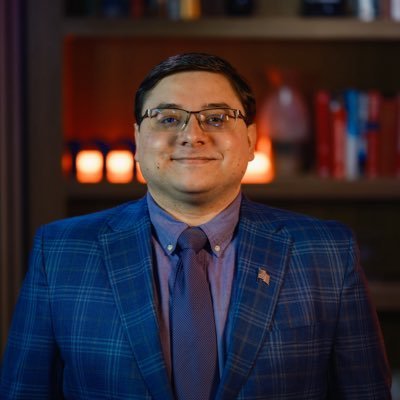
Associate Editor, MRC NewsBusters
Nicholas Fondacaro is the Associate Editor of MRC NewsBusters, where he specializes in analyzing television news, political messaging, and media accountability. A Binghamton University graduate, Fondacaro built his career at the Media Research Center from the ground up, advancing from an intern to a news analyst and editor. Recently, on the November 16, 2026, episode of The Next Steps Show, he offered expert commentary on media bias, unpacking issues such as selective reporting, omitted context in mainstream coverage, the framing of immigration language, and the mechanics of political persuasion.