


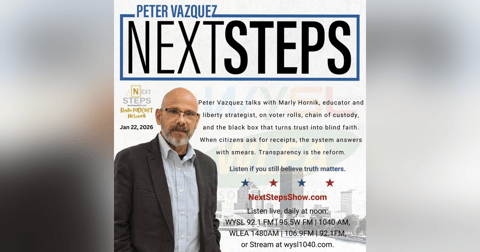

New York Election Audit meets real-world resistance: Marly Hornik lays out voter-roll gaps, chain-of-custody failures, and a due-process fight to open the books. Peter Vazquez and Gary Stout press the hard question: if government refuses transparency, is it governing by consent or by compliance?


When a citizen asks, “Show me the books,” and the system answers with a smear, the republic is already sliding into a managed life. Peter Vazquez sits with Marly Hornik educator, strategist, and champion of individual liberty, and with Gary Stout in studio, to pull election reform out of slogans and into receipts: voter rolls, statutory compliance, chain of custody, and the black box that turns public trust into blind faith.
Marly, an inspiration to thousands of volunteers working to improve and reform our elections, lays out why accountability so often requires courts, why New York’s own records matter, and why transparency is treated as a threat. Then the stakes widen: a federal lawsuit challenging retaliation by state power, and the warning that elections do not need to be hacked to be controlled, they only need to become unauditable. Preserve the record, get punished. Demand oversight, get branded. This is the oldest American argument: do officials answer to the people, or do the people answer to the system.
Promote your brand on the Next Steps Show, airing on WYSL1040.com's AM 1040, FM 92.1, and FM 95.5 West stations. Discover more at nextstepsroc.com/advertise-with-us or dial (585) 346-3000 to get in touch with the WYSL team.
Have you ever dreamt of sharing your unique voice, stories, or expertise with the world through a podcast? Perhaps you're bubbling with ideas but uncertain about where to begin? The journey from idea to launch can be daunting, but that's where we come in. Dive Into the World of Podcasting with Next Steps Radio PODCAST Network! Visit NextStepsRoc.com or call Peter at (585) 880-7580.

Peter Vazquez: In a republic, citizens are not criminals for asking questions. When institutions demand trust but refuse transparency, credibility collapses and participation follows.
Guest Introduction: Peter welcomes Marly Hornik, educator and strategist, a champion of individual liberty and an inspiration to thousands of volunteers working to improve and reform elections. Gary Stout joins in-studio.
Marly Hornik: Real America Vote (DBA of New York Citizens Audit) focuses on election validity using the state’s own official records: voter roll compliance, lawful registration, and whether records can prove that qualified voters voted and ballots were counted fairly.
Gary Stout: The public response to audit concerns often feels like indifference or hostility. There appears to be strong incentive to maintain the status quo.
Peter Vazquez: New York insists there is no real problem, yet major roll-cleanup actions have happened only after litigation pressure. Why does accountability require court intervention?
Marly Hornik: Courts often block challenges by denying “standing.” She points to a recent Supreme Court development she believes strengthens candidate standing to contest election process harms.
Machines vs. Records: Marly emphasizes that her work is not primarily about voting machines. Her argument centers on due process: if the process is hidden, citizens cannot verify outcomes. If machines are used, she argues for public transparency such as open source review and auditable proof.
Peter Vazquez: If systems are sound, why are people disengaging?
Marly Hornik: A “black box” between voters and representation creates psychological disenfranchisement. People sense that outcomes are not verifiable, so they doubt that voting matters.
Lawsuit and Retaliation Claims: Marly describes a federal lawsuit against Letitia James and the New York State Board of Elections, alleging retaliation and intimidation for reporting audit findings, including public smears and investigative pressure. She argues transparency alone would shift political incentives and restore trust.
Peter Vazquez: Why defend so aggressively if there is nothing to hide?
Marly Hornik: “Who audits election administrators?” Her answer: too often, they effectively audit themselves, which invites abuse.
Tina Peters Letter: Marly explains her letter to DOJ official Ed Martin about Tina Peters, arguing that record preservation for federal elections should not be treated as a state-level crime. Gary adds concerns about Peters’ treatment in custody.
Closing: Marly directs listeners to realamerica.vote, encourages support for litigation and public oversight, and frames the central issue as citizens’ right to verify government claims without being smeared or silenced. Peter closes with a call to be vigilant, verify, and remain a voice for liberty.

CEO and Chairman
Marly Hornik leads RealAmerica.Vote as CEO and Chairman, standing at the crossroads of citizenship and conscience. An educator by craft and a strategist by instinct, she has become a rally point for Americans who believe liberty is not inherited automatically, but defended deliberately.
She has worked on the front lines of election reform in New York and on the national stage, translating public frustration into disciplined action and measurable oversight. From her leadership as Executive Director of New York Citizens Audit to her role as CEO and Co-Founder of United Sovereign Americans, Hornik has helped build movements that refuse to confuse “trust” with “verification.”
Her work is powered by an unglamorous virtue that changes history: persistence. Thousands of volunteers have answered her call, not because she promises easy victories, but because she insists on something better than slogans—accountability. Where others accept the fog, she demands clarity. Where institutions drift, she calls citizens back to duty.
In an era that rewards noise, Marly Hornik makes a different wager: that truth still matters, and free people still have the will to secure it.