

 iHeartRadio

 Apple Podcasts

 Spotify

 TuneIn

 Podchaser

 Castro

 Amazon Music

 PlayerFM

 RSS Feed
Marly Hornik: Election Integrity Means Enforcing the Law

Election integrity advocate Marly Hornik joins Peter Vazquez to examine voter eligibility, New York registration records, Monroe County accountability, and Westchester ballot-scanner failures. They debate enforcing existing law, the SAVE America Act, and what evidence voters deserve.
Key Takeaways
- Marly Hornik argues that election administrators must enforce existing voter-qualification requirements and explain how eligibility is verified.
- Peter Vazquez revisits earlier on-air invitations from Monroe County election commissioners to examine disputed registration records with citizen investigators.
- Westchester County's November 3 ballot-scanner failures prompt questions about election programming, verification and independent oversight.
- Hornik and Vazquez debate whether the SAVE America Act would improve compliance or whether enforcing existing election law should come first.
- Possible voter-roll errors require investigation; flagged registration records do not, by themselves, prove illegal votes.
Today, Marly Hornik, founder and CEO of RealAmerica.Vote, returns to The Next Steps Show with Peter Vazquez to confront a fundamental question: What good are election laws if the people responsible for administering them cannot explain how they are enforced? The conversation examines voter qualifications, constitutional responsibilities, election transparency, and the difference between political promises and measurable accountability.
Peter revisits invitations previously made on air by Monroe County election commissioners Peter Elder and Jackie Ortiz to meet with citizen investigators about disputed voter records. Hornik discusses responses from election officials elsewhere, while caller Gary Stout describes his difficulty securing a local meeting and raises questions about voter check-in procedures. The central demand is not to assume the outcome of an investigation, but to examine the underlying records and provide documented answers.
The conversation turns to Westchester County's November 3 ballot-scanner failures. Peter discusses the state's explanation involving inconsistent election programming and its planned bipartisan review. Hornik questions whether the public can fully verify election outcomes when critical election technology operates under proprietary restrictions. The hosts ask where technology, constitutional rights, and public oversight should intersect.
Hornik also discusses the article she wrote with former Omaha mayor and U.S. congressman Hal Daub, arguing that the nation's existing constitutional and statutory obligations deserve enforcement before lawmakers add new requirements. Her liquor-store identification analogy fuels a pointed exchange over voter eligibility, the proposed SAVE America Act, and the responsibility of election officials to apply the law consistently. The conversation broadens to state authority, individual liberty, and the rights of citizens to hold government accountable.
After the interview, Peter examines the Public Interest Legal Foundation's complaint identifying potential irregularities in New York registration records. He distinguishes records flagged for review from proof of unlawful voting, and asks what state and county officials have actually investigated or corrected. Proverbs 28:4 frames the closing reflection on law, courage, and civic responsibility. Caller Gary Stout returns to the question of unanswered local concerns.
Allegations and legal interpretations expressed by guests and callers are attributed to those speakers and are not presented as independently proven election violations.
Guest: Marly Hornik | RealAmerica.Vote | https://realamerica.vote/ Original broadcast: November 20, 2026, at 1:00 PM EST (America/New_York). The Next Steps Show with Peter Vazquez on WYSL/WLEA, Voice of Liberty Network. Putting People First.
Keep the conversation going: More episodes · Watch videos · Read commentary · Send a voice message. Live weekdays at noon Eastern on WYSL and WLEA.
Advertising and sponsorship opportunities.
Frequently Asked Questions
What does Marly Hornik say about the SAVE America Act?
Hornik argues that existing constitutional and statutory election requirements should be enforced before adding another federal law. Peter Vazquez examines how officials can be held accountable for enforcing those requirements.
Why does the episode revisit the Monroe County Board of Elections?
Peter Vazquez follows up on earlier on-air invitations from commissioners Peter Elder and Jackie Ortiz to review disputed voter-registration records with citizen investigators, asking what examination and answers followed.
What went wrong with the Westchester County ballot scanners?
The discussion covers the November 3, 2026, scanner failures and the New York State Board of Elections' subsequent explanation involving inconsistent election programming, as well as questions about independent review.
Do questionable voter-registration records establish election fraud?
No. The program distinguishes potential duplicate or inaccurate registrations flagged for review from verified unlawful votes, which require additional evidence and investigation.
Marly Hornik: Election Integrity Means Enforcing the Law
The Next Steps Show | Episode 745 | Original broadcast November 20, 2026
Edited reading copy based on the November 20 actual-broadcast transcript. Commercials, music, weather, news and station-break announcements are omitted. Source speech recognition may contain mistaken words, unfinished phrases or misheard names; the dialogue has not been independently fact-checked. Speaker identities are assigned where clear from the discussion. Source time markers refer to the original transcript and may differ from the edited Podbean audio.
Opening: What Makes an Election Valid?
Source time marker [00:01:35]
Program introduction: In a world that seems to change daily, what will you do next? Welcome to the Next Steps Show with Peter Vazquez, a starting point for discussion.
Peter Vazquez: Yeah. Check it out. Alexander Hamilton on November 21, right, in 1787 in the number nine, he said, the representation of the people and the legislator by deputies of their own election. Isn't that something? What about that word deputy? See? Doesn't that kinda mean, you know, you're kind of accountable to your own electorate or something like that? I don't know. But I'll tell you what. The right to vote means little if the laws protecting that right are not enforced. Right? I mean, that seems pretty logical to me. Election integrity, that's not a partisan issue, amigos. Right? I mean, you'd think that anybody who cares to vote or wants to be in a ballot would say, Mida, that's a constitutional responsibility.
Peter Vazquez: That's a that's a public trust demand. That's what I think. So see accountability or something like that. You know, it's my honor to a gun. Right? Bring to you somebody who's made it their mission. Right? To ensure that there is that accountability, that the questions are being asked and that, well, you know, when the push needs to push a little harder that she's pushing. Ladies and gentlemen, the honorable Marly Hornik, founder and CEO of RealAmerica.Vote. Marly, thank you for joining me in the Next Steps Show today.
Marly Hornik: Well, it's great to be with you again, Peter. Yeah. I totally agree with Alexander Hamilton. Everything he says, I disagree with it. He's just... How could they have envisioned this whole system so perfectly? And, you know, I think a lot of people when they look at this question about election integrity, we're looking at it right now based on how it's defined on social media or how it's defined by politicians. But we have to look at it the way Hamilton and Madison defined it. What did they think a valid election was? And are we having that? That's the real question.
Peter Vazquez: I completely agree. And that's why, you know, I love you guys coming on every other month, you know, and having these discussions. We just got over a, you know, an election here that... Interesting. No one seems to be crying foul too loudly as I expected.
Marly Hornik: Yeah. Well, we got over an experience, but it wasn't an election because the states didn't qualify the voters according to their own laws in every state. That's that's what an election means. When the people choose congress and those those people who choose are defined under state law in every single state, and those laws are enforced, and those laws are upheld. And we can see the results, and we can... You know, it's transparent, so we know we chose. That's an election. And part of... You know, again, like, part of the problem we're having is we're following around all kinds of other definitions of an election that are somebody else's idea. They're not our social contract.
Peter Vazquez: When you say qualify a voter, can can we go a little deep into that and tell us what that means? You know, yesterday, I had the, commissioner of BOE here, locally on the Republican side, and he's also the Republican leader here. And, you know, he stands by his candidates and that they were all well qualified. But it sounds to me that you're defining qualify a voter a little differently in regards to election. Is that what they mean by...
Source time marker [00:05:05]
Peter Vazquez: Explain that.
Marly Hornik: Sure. Let's use a simple example.
Peter Vazquez: Uh-huh.
Marly Hornik: Let's say you're a liquor store owner and a 10 year old girl comes into your store and she wants to buy, you know, a case of Grey Goose and two bottles of Tito. And, she tells you she's 21. And you say, okay. Sure. Here you go. Who committed the crime? Well, you did. You sold liquor to an underage child, and you are criminally accountable for that because everybody... You don't need congress to come in and tell you how to figure out if it's a 10 year old or a 21 year old. Everybody knows you just get their ID. You get their documentation because people lie all day long every day.
Marly Hornik: People lie. And for various reasons, I mean, I, you know, I drive 70 on the highway when it says the speed limit is 65. Mhmm. That's not right, but I do it anyway pretty much every time I'm out on the highway because I'm in a hurry. That's my... You know, I think I have that privilege. So the problem here is that, you know, the state's promise to qualify the voters according to the law, and every state has a requirement of United States citizenship for voting. In any election, every single state has that as part of their constitution. Every single state has a kind... You know, some kind of an address requirement and a time requirement.
Marly Hornik: You have to have been already at this address for x number of days or weeks. They have requirements, and they don't enforce any of them. There's no meaningful enforcement. And they say if we ask for that documentation, we are actually disenfranchising the voter. We are denying them a right to vote when we ask for their documentation. It's it's insane. Yeah.
Peter Vazquez: It is. Another lie of the left, and the thing is they always use race to justify it because the next statement after that is, well, you know, people in, those disenfranchised neighborhoods, and then specifically, they start mentioning black and brown, which is also more disgusting to me, than anything else. You know, Marly, when I went to go vote, this past election, they they verified my name and my address by asking me if... And this has been reported across the board because this is apparently how they do it. And they asked me, hey. Is your name so and so? Do you live at this address? Is this your... And I said, yeah.
Peter Vazquez: I signed, and she looked at it and said, okay. And handed me a blank piece of paper.
Marly Hornik: Yeah. Called a ballot.
Peter Vazquez: You
Marly Hornik: know? More valuable than any bill. You know, any any... Which we don't even have bills anymore. So that's not even... Like, our, you know, our grandkids aren't even gonna know what we say when we say, would you mail a $100 bill? They're gonna be like, what's that? Yeah. But... Yes. You know, the idea is that if you lie, that's on you. You know? And if a million people show up at the polls and lie, it has nothing to do with the responsibility of election officials to have prevented that from happening. You know? But the founders weren't, you know, attached to these kind of illogical and stupid arguments. They were like, no.
Marly Hornik: We need qualification because otherwise... And you think about this. This is the second sentence of the United States Constitution. That tells you something because they wrote that thing with a quill pen.
Source time marker [00:08:38]
Marly Hornik: That tells you that in their mind, there was no reason to write the rest of that contract out. There was no purpose for it if we didn't establish first and foremost the election of the deputies by the people. Right? The representatives are chosen by qualified voters. That was the first thing they put down. You can't have a secure system that protects your life, liberty, and pursuit of happiness if you have no control over the people who make the laws. It's common sense.
Peter Vazquez: Well, I mean, the... At least in this nation, right, we give authority to the government, not the other way around. So people seem to have forgotten that. I'll tell you, I have had students at, when I... Teaching college, who have told me that they put, elected officials on pedestals. So my question to them after that was, like, okay. If you do that, then how are you holding them accountable? Because once you put them on a pedestal, what, you're gonna justify every reason that everyone's saying, wait a minute. They shouldn't be on a pedestal. They're not even properly elected.
Marly Hornik: That's that's great. And are they some kind of immaculate human? They've taken this position, and all of a sudden, they no longer have any weaknesses. They no longer have ambition. They no longer have self interest. They no longer have the potential to be barbaric or corrupted. You know? Because they're in this position, they're an exalted being, like a Jesus figure who is, you know, now determining whether or not you have violated a parking rule. I mean, come on. You know? But I agree that a lot of the education system has created this idea that when we have a problem, we turn to the government. But, you know, I think, previous generations have been more clear about this issue about who's responsible for solving problems, and I think we'll get back there again.
Marly Hornik: I don't... You know, I'm not here to either say, like, oh, the previous generations knew everything and had it all figured out because, obviously, we haven't got everything figured out. So No. There's still more.
Peter Vazquez: We've got a long way to go, but we definitely need, you know, to ensure that the people we're electing and the process that we use to elect those people, is rock solid. Otherwise, we're gonna continue, you know, to... This rabbit hole is just gonna get more complicated and eventually almost become unfixable, I would think.
Marly Hornik: Yeah. Well, I mean, look what happened during COVID as another example. You know, we were deprived of so many liberties, and we continue to be deprived of liberties in New York state. Children cannot attend any school in the state, public or private, if they have not complied with every single health dictate that comes out of the executive branch of New York state government. So, you know, you could have breastfed your kid for three years. You could have, been attentive to every aspect of their diet and their mental health and every possible conceivable way a human being previously has assured the health and longevity of their child. But if you don't agree with what the state says has to happen, then you can't put your child in school.
Marly Hornik: Like, that is an insane overreach Yeah. Well honestly.
Peter Vazquez: Look at what they're doing to the Amish Mennonite communities in the state.
Source time marker [00:12:08]
Peter Vazquez: You know, they're they're literally driving him out of here because they're coming after them for their own beliefs. And I'm like, leave these people alone. You know, as a matter of fact, when I was, on a cruise once, we were in one of those islands of Mexico, and they were explaining, that because of, you know, the very things we're seeing here in New York, there's been an influx in the Amish community going down to places like Mexico, working out a deal with their government saying, hey. Leave us alone. We'll provide you agriculture. And, I mean, it makes sense to me. That's happening in Mexico. I don't understand why a nation like this where people have the rights to be free, that's not happening.
Peter Vazquez: Nationally recognized election integrity advocate, ladies and gentlemen, the honorable Marty Hornik, founder and CEO of Real America. Marty, when we get back, I wanna get into an article that you and, and the honorable Hal Daub have written recently, and get into detail. It's called just enforce it, and it seems to make sense to me. We'll be right back right here in the Next Steps Show on the voice of Liberty Network, WYSL, WLDA. And, Mira, until I open the lines, you can go on my social media. Leave me a message. We're on Facebook. We're on Rumble, and you can even send me a text message.
Monroe County, Voter Records and Local Accountability
Source time marker [00:14:40]
Peter Vazquez: You know, there are organizations out there, ladies and gentlemen, that, they have a mission and they go out every day and they do something, and that's great. But then there are organizations out there that are not only going out there and doing things, they're going out there and changing the future. You know what organization comes to mind right now? That is youth for Christ, yfcrochester.org. Check out what they're doing. Right? You know what? Give their website, and there's a couple tabs. Right? You could hit the donate tab that'll check this out. Imagine being a mentor for a young child whose hope has been diminished, hey, by the very people we've asked to lead our communities.
Peter Vazquez: Isn't that something? See? And to continue this conversation, Tanimo, see the honorable Marly Hornik, founder and CEO of RealAmerica.Vote. And that's another great organization that you need to go to that website and see, say how can I help you? Marly, thank you again for your time. Marly, before we get into this article, I wanted to ask you first, though, and I... I'm gonna pick on the local people here because we had them on the air. You had talked to them. They had shared with us. But, you know, this is kinda in all the work that you're doing nationwide. See, the local commissioners back in March and then last year in October when I had them here, they had promised that their doors are open and the files are open and that we can come in.
Peter Vazquez: We, as in, you know, those of us that are asking questions and ask other questions, go through the voter rolls, and put a plan together. And I know that hasn't happened here locally because I've been talking to Gary Stout who... Who's been trying to head that up here. But are you seeing any cooperation with any kind of board of election officials, state or otherwise, in any of the states you're working in or counties?
Marly Hornik: Absolutely. Yeah. I think that there are a bunch of places where this is being taken far more seriously. And I think that those are the places that are experiencing political risk because of the problems we're having. Because these problems don't stop at the outcome of any particular election. For example, let's take this study that, you know, I know we've discussed this before on the air. I don't need to go into it deeply, but the Muamdani study that we did showed that New York City and New York State counted votes from people who don't exist from likely foreign nationals and from people who had no, no address, no active address within the election time frame in the election district.
Marly Hornik: So this creates a problem because those are votes counted but it's also has to do with congressional apportionment and this is a national question and it also has to do with the electoral college which is dictated by congressional apportionment. So the number of people who are on your voter rolls is material if they're considered to be qualified and the trust process says we have assumed the state has qualified these people, that number of people is part of the factor of determining how many congressional seats the state has and how many electoral college votes it has and how much federal funding it's it's, qualified to get.
Marly Hornik: So the states... Getting back to your question, Peter, the states that are interested in solving these problems are the ones that have, you know, between three and five electoral college votes. They could get wiped off the map if California and New York and these other states don't start adhering to our social contract and the agreements that the states made.
Source time marker [00:18:19]
Peter Vazquez: You know, that's exciting news, Marty, that there are states... You know, because I do get concerned that, you know, this issue is so large that some states may not even bother or feel that they're not part of the problem or something along those lines.
Westchester Ballot Scanners and Public Verification
Source time marker [00:18:32]
Peter Vazquez: I wanna back up a little bit, though, to Westchester County here in New York in this, previous elections. You know, there was that inconsistency where we initially thought it was a paper issue, but the official cause was inconsistent election programming, which, you know, the word programming and inconsistency due to an update. I mean, that's those are the issues you and I have talked about many, many times and you have talked about nationally. But one thing that concerns me though, and maybe you can help me understand how this process makes sense, Marly. Because the state board here in New York promised a comprehensive bipartisan review following the certification of votes, but it's my understanding that once these votes are certified, any findings of something wrong, it doesn't really matter for that election.
Marly Hornik: Yeah. It's really, really unusual for, an election to be, you know, reviewed and overturned after it's certified, and especially to think that political parties would willingly undergo such a humiliating process is even less likely.
Marly Hornik: You know, I think there's an issue about the machines. We often... Again, we get led around about this machine issue. And so then we think that we're arguing with something that was previously legitimate. It's like, you know, you're kind of... You're arguing with a Band Aid, but there's eight other Band Aids underneath that Band Aid, and you're still not looking at the wound itself. And if you don't go and heal the wound, then you'll just end up with more Band Aids. Right? So this machine issue is exactly like that. Now, again, that second sentence of the constitution says that it is the people who choose congress. The qualified voters choose congress.
Marly Hornik: That means that we have to have transparency in the process because we can't simultaneously choose congress and trust in an outcome that's unverifiable. And so what we functionally agreed to, we didn't exactly agree to it, but we haven't correctly challenged it, let's say, yet is a system where the actual counting process is protected under intellectual property rights as a trade secret of election technologist.
Marly Hornik: And that is a legitimate right. Right? Intellectual property rights are very important in this country. But when you have a conflict of rights where you have this intellectual property right is directly in conflict with a liberty right of every American citizen to be part of choosing Congress, then you have to choose a winner in the in the battle. And in this particular battle, if you choose the rights of the technologist, you basically forego our republic. We cannot have a republican form of government. We cannot have the life, liberty, and property securities that are provided by a government, a legislature that we directly control if we don't have that right to choose upheld.
Marly Hornik: Again, that's why it's the second sentence. So I don't really care from that perspective, you know, why the machines went down across the entire county of West Chester, I don't find any argument compelling regarding, you know, the legitimacy or the human error or the oopsie because the fact that we are already allowing West Chester County's IT department to sign a contract with election technologist that overrides our fundamental right, our our most important task and civil liberty as American citizens, the only job we have in the constitution, that's where the principle.
Source time marker [00:22:45]
Marly Hornik: Instead of saying, well, we have all this equipment, and so now it just didn't happen to work on election day, but, you know, otherwise, we're really here and we're all about you. Like, I'm not buying that.
Peter Vazquez: Yeah. Well, you know what? Especially with all the you know, all the misinformation that they've put out because they tend to... I say they. I'm talking about government officials, especially some on the left. They don't... I've noticed they don't always, like, outright lie even though they do that as well. They just kinda extend the truth a little bit or they change the wording so it sounds more warm and fuzzy. Like, how dare you say that those machines are bad? They're adaptable to, you know, to everybody that...
Hal Daub and the Question of Existing Election Law
Source time marker [00:23:23]
Peter Vazquez: Even if they can't read. I'm sorry. Just the nonsense behind some of this. Ma'am, Hal Daub, who is that for our listeners?
Marly Hornik: Hal Hal Daub. Yes. The honor of So I appreciate you giving me the title of honorable, but I have not technically earned it. He has. He, was the mayor of Omaha, Nebraska for two terms, so eight years as mayor of Omaha, and then four terms in the United States Congress for the state of Nebraska, representing the district that includes Omaha. And he's also an attorney, with a strong constitutional focus. So he's someone who has a lot of, you know, personal experience in governance and in, I would say, adhering as best as he knew how and saw fit to those principles of limited government that are protected in our constitution and defined in our constitution, which are so abhorrent, I suppose, to those who are in the positions mostly just to get power.
Marly Hornik: They don't like the limits, but, but that's who Hal Daub is. That's his background. An interesting anecdote about Hal is that he also was, responsible for introducing justice Clarence Thomas to his wife, Ginny, many, many years ago. So he's cool. Been a figure in American politics for a long time. Yeah. Kind of a sweet story.
Peter Vazquez: Oh, man. I'll tell you... And I love that chief justice. I'll tell you. I love the work that he's doing. I love his courage, and I love his wife's courage. He's like, listen. I can speak. I get it. He's a judge. He's a... He may be he may be restrained in some ways, but I'm not. I love that. You know? I love that a lot. So you guys wrote an article, and it's called Justin Forcer. Right? And, but let me let me let me share this because I wanna quote something you had said in the... Real quick. And we're gonna be gonna break here in a second. So let me make sure I get this in because the house passed the SAVE America Act, I believe it was two eighteen to two thirteen in February of this year.
Peter Vazquez: And then in March, the senate failed at 53 to 47. And then as of as of today or as of yesterday, I should say, when I looked, the legislation had not become law. And the thing is the National Association of Counties raised concerns about county implementation, but in this article, Hal Daub, the honorable Hal Daub, and the honorable Marly Hornik, right, you guys said the save act already exists. And when I get back from break, we're gonna get into detail as to why you guys are saying that. Ladies and gentlemen, Mira, I'm gonna go to break. Right? We gotta pay some bills and do our thing here. Don't go nowhere.
Peter Vazquez: Right? And when we get back, don't forget, you can reach me on social media.. It's me, Peter Vazquez. I'm the voice of liberty, w y s l, w l e a.
The SAVE America Act, Voter Qualifications and Enforcement
Source time marker [00:32:00]
Peter Vazquez: I meet a Negusta's chicken fry and a Friday night come all the time. You know, Friday, it's time for you to start settling. Meet us. 07:00 is my time. 07:30 or somewhere around there. Grab your bride. Grab your girlfriend and say, baby, I love you. Tonight is just us. Because family is the reason why we get up in the morning and do the work that we do.. Yep. Welcome back, Akita, to the Next Steps Show, and we have somebody pretty darn special. I think she is. Right? Because she says, listen. Right? We're gonna we're gonna hold our nation, see, to the highest standards, and that is Marly Hornik. Marly, thank you again for spending your, time with us this afternoon.
Marly Hornik: Oh, it's a pleasure to speak to you, Peter. I love how you're interested in, you know, looking at this problem honestly and all the way back to the root. We can't just yell and scream on social media. We have to solve the real problem.
Peter Vazquez: I'm so sick and tired of yelling and screaming. The thing is this, you know, and I've said this a million times. The more we yell and scream, the more ammo we give to the other side to, well, to make us look like we're yelling and screaming. And that's it. So when we come at things the way that you do, for example, when you come with numbers, when you come with facts, and the only thing the state can do like they did to you and your team back when you were with, Citizen Sod, it was try to shut you up, which is what our government... I mean, like, what world do we live in The United States when they're shutting down a group of citizens to have found something so critical to our nation national security, really?
Marly Hornik: Yeah. I couldn't agree with you more. And, you know, you were talking before about the people picking up and leaving, you know, the Amish picking up and leaving and maybe going to Mexico. We can't really... We've really lost the thread if we allow that to be what happens to this country. We've really misdiagnosed the illegal immigration problem or the immigration problem, let's say, not the illegal one. The immigration problem. The immigration problem we have are the political asylees fleeing within our own borders, American citizens fleeing tyrannical government. This should never be tolerated by us. We should be ashamed, honestly, to hold our heads up as Americans knowing how many people have fought for us to have this country that we're actually talking about this as so called voting with your feet, that you would tear yourself out of the communities that you're established in, your friendships, your relationships, your schools, you know, all of the things that a family has to basically pick up and turn its back on and start somewhere completely fresh.
Marly Hornik: That is not voting with your feet. That are... Those are people who have decided they no longer have political equality and economic liberty, and they're forced to relocate.
Peter Vazquez: Yeah. It almost seems like that's what the Democrats, Democrat socialist of America, what that party and those elected, you know, on on... Under that flag wants to happen. You know, I wanna I wanna ask you on that because, you know, again, in this article that you had written, it says, you know, you... The save act already exists. But USC 18 section... Or The United States code 18 section six eleven, it says, generally prohibits noncitizens voting in federal elections, with limited exceptions. I haven't found a lot that really describes what that word limited exception is, and I assume the state has similar language.
Source time marker [00:35:33]
Marly Hornik: Well, the federal code basically has to... It requires that individual to know that they have committed a crime. Typically, you can't indict someone for... On a criminal basis if they didn't realize at the time they were committing a crime. In our country, we consider intent to be part of the predicate for accountability. So, you know, yeah, that code exists, but I don't... You know, again, we're not dealing with onesies, twosies. We're dealing with a system that no longer cares whether you're an illegal immigrant or a noncitizen or someone who doesn't exist when you register to vote and get your ballot, cast it, and have it counted. And if the system no longer cares whether you have those qualifications, then it's the system that has to be indicted.
Marly Hornik: And there is clear precedent, clear case law from the United States Supreme Court that implicates the election officials at the state level in particular, but perhaps at the county level in some place with the failure to fulfill the promise of the voter qualification clause of the constitution, which is the original save act.
Marly Hornik: I mean, it's foolish to think that Hamilton and Madison would have set up the system without insisting that voters are, you know, eligible to vote, that the states have to, you know, the states don't have to do anything to make sure that happens. So we're not looking at, you know... I mean, there definitely are individuals who break the law, and they break the law regarding our elections. That's one problem. But the biggest problem we have is the reason those individuals are able to successfully commit that crime is because no one cares. Mhmm. That's No one in charge of the system is looking to see if they have that right. It's just back to the liquor store.
Marly Hornik: Okay. If you sell a 10 year old a bottle of liquor because she says she's 21, you committed a crime because you don't just have the responsibility of taking her word for it. You have the responsibility of checking. And you shouldn't need the Save Act. You shouldn't need Congress to step in and identify which documents are, you know, are good enough for you to make the decision to sell that bottle of liquor to a girl. You are responsible. You have to be certain that you have qualified the child.
Peter Vazquez: That is 100% correct. You know, it irritates me. I... Unfortunately, now that I'm working on it and it's getting better, I have the habit of smoking. And I, had renewed my license but forgot to grab my new license when I came. And I was buying a pack of cigarettes, and they scanned my ID. Now mind you, I'm 54 years old, and it's not like I'd look 21. Or I don't I don't even look under 30. Right? And they wouldn't sell me the cigarettes because the ID that I gave him scanned invalid. And I remember I asked them, like, but I don't need an ID to buy cigarettes. And my my...
Peter Vazquez: I... It just... The whole thing was nuts. But my question to them was, listen. You're looking at me. Everything in front of me presents that I am over 18 or over 21, whatever the age is. You know, why do we have this issue? And their response was, well, because we have to make sure that we're protecting the liability of our store and so on and so forth.
Source time marker [00:39:04]
Peter Vazquez: So, anyways, the same logic to me would apply to this whole voting, and election integrity, which makes sense. And if we're following the rules, you're right. We don't need to say bank. But because things aren't being followed, we do need it.
Marly Hornik: Well, no. We have to insist that the law is upheld. The same logic does apply. But, again, here's another constitutional nugget. Here's another piece of wisdom from Madison. He said that in this system, ambition is always going to have to counter ambition. What he meant was if you have a piece of turf inside of that United States constitution, if you... Let's say you're a representative or you're a, you know, whatever your your lane is that's defined and identified in the constitution and gives you power, you should always expect for someone to be trying to take that power from you because that's how politics works.
Constitutional Rights and the Limits of Government Power
Source time marker [00:40:02]
Marly Hornik: It's how it worked in 1789. It's how it worked in ancient Rome, and nothing has changed. People are ambitious, vindictive, and rapacious. That hasn't changed either. So we have a
Peter Vazquez: Three.
Marly Hornik: Constitutional turf. Right? When it says the people choose congress, that's turf. It's not just words on a page. That's turf. And the idea, if we think that no one would like to take that job from us to be in charge of who gets to sit on Capitol Hill and oversee a multitrillion dollar economy and the reigns of world power. We are literally in, you know, mister Rogers' land. Yeah. So we have to defend it. We can't just say, well, this is the world we're in, and that's already been ignored, and we just accept it, and now we need to save act. No. The problem with the save act is it's gonna be just like every other law.
Marly Hornik: It's gonna be ignored. Have to defend our turf. And I don't mean, you know, violently at all. But the first principle that we have to figure out is how to help people understand. They have to get from a to b. Right now, everybody thinks that the graph they're looking at on social media are either real or fake, that the election outcomes are either true or false, and that, you know, the people are either doing the right thing or doing the wrong thing. But we don't understand how the system has been skewed away from our rights. We have to defend the right. That's the whole entire purpose of the United Constitution.
Marly Hornik: It's not to secure the machine. It's not to secure power for a political party. It's to secure the sovereignty of the citizens over the law, and we cannot allow that to be divided. We have to enforce it there.
Peter Vazquez: And just like I said when we started, election integrity is not a bipartisan issue. Ma'am, I truly appreciate your time. You know, I'll tell you time goes by so fast. In that same article you had said, make cheating more painful, and I appreciate that. Ladies and gentlemen, the honorable Marly Hornik, founder and CEO of Real America, RealAmerica.Vote. Marly, I appreciate you, and may God continue to bless you and the work that you do.
Marly Hornik: Thank you so much, Pete. It's been a pleasure to speak to you today, and I look forward to next time.
Peter Vazquez: Absolutely. That'll be the month after next, ladies and gentlemen. And, Mira, coming back for the last segment, lines are gonna be open. Mira, I wanna hear from you because this election integrity stuff. Right? It needs to be talked about over and over and over and over again. It's dead important. We'll be right back right here in the Next Steps Show with Peter Vazquez and the voice of Liberty Network, WYSL, WLEA.
Closing Commentary: Proverbs 28 and New York Registration Concerns
Source time marker [00:44:37]
Peter Vazquez: Appreciate that, senor, Bob. You know something, though? You know, when we talk about local, you know, sometimes I wonder because, you know, some of the things that we do or that we allow our leaders to do, I scratch my head and I'm thinking, did we really just let that happen? And why? You know, it's like this past election. Why? Why why are we reelecting someone like Kathy Hochul? Or someone like Jeremy Cooney? Or someone like, well, the various jokers that we have, you know, running this state at this moment. It's bizarre to me. Very bizarre. Never understood. Five eight five three four six three thousand. Eight six six five five two one zero zero nine.
Peter Vazquez: You know, give me a call. You know, Proverbs, let's get a little Bible this year for a second because you know me. I like to talk a little Bible sometimes. Right? Because, I mean, at least for me and in my world, the Bible's never led me wrong, believe it or not. I just, like, find a tough time, and I'm like, you know what? Let me let me let me check there real quick and just see what that manuscript has to say. Right? And when you look at books like Proverbs 28... Right? Because, you know, Proverbs 28 sits within a collection of Solomon's sayings, right, and repeatedly contrast the righteousness to the wicked.
Peter Vazquez: Now listen. I'm not getting bible thumping here. I just wanna... I wanna show a paradox, right, that... Well, you know, sometimes we gotta consider because check it out. Listen to this. The paradox is this. Because the wicked do not fear God. They fear people. But because the righteous fear God, they do not fear people. It's an interesting statement, isn't it? See, the thing is we have the courage. We have the ability in this nation to continue to maintain a nation, right, that is focused on god, country, and family. It absolutely does. I mean, check it out. Proverbs 28 verse four says that they are... They that forsake the law praise the wicked, but such as keep the law content with them.
Peter Vazquez: Again, the Bible, a manuscript. Isn't that something? See? That's why that's why I read it. That's why I can't go wrong. I don't know what to do with my telephone here. Bizarre. See, and I bring this up because election integrity... You know something? Election integrity is, well, you know, it's it's it's critical, see, to a nation that was put together by a bunch of people that left an oppressive king. Although we have no king rallies in this nation, which is really bizarre to me. I mean, election integrity, you know, that's not about which party wins. You know that. For us, seeking election integrity and the accountability behind it is about whether the law is enforced.
Peter Vazquez: She said that. Then we ask what law? Do we need to save act? Marly said no. Right? The honorable Hal Daub said no. We don't because we got it in place, and I agree with that. See, we do have a habit of, of just continuously adding more rules in response to something, and that's the bamboozle ness. That's the politics. Five eight five 3463 thousand. What do you think? I mean, check this out. The Public Interest Legal Foundation in 10/29/2026, this year.
Source time marker [00:48:10]
Peter Vazquez: Right? They they they they filed, let me see if I can get it here. They they filed a complaint regarding duplicate records, New York state res... Registration records flagged for potential errors. There was 20,420. Six hun... Or 6,485, apparently, duplicate registration. I mean, the numbers go on. We talk about this, but they filed a former complaint against the New York State Board of Elections on October 27, alleging that New York is failing to comply with the federal voter registration maintenance requirements under Help America Vote Act. They announced, right, its findings in October. Piddle piddle... What's happened? Well, nothing's happened. Right? Nothing. The complaint request that the State Board of Election here in New York State acknowledge, right, the alleged violations, examined, submitted records and correct verified discrepancies, but I haven't seen that happening.
Peter Vazquez: Have you? Have you seen that happening? Because I haven't. You know? And listen. This isn't this isn't me saying, hey. Listen. This organization found these, these discrepancies, and they're automatically voter fraud. Nope. That's not what anybody is saying. But like we've talked before and like we shared with with people like the commissioner, and Republican, committee chair. Right? That what people want is answers. Hey. I found my phone. What people want is answers. You can send me a text too in case you forgot. I mean, they they they... That's it. I don't think that's hard to ask. Right? But when we look at things like, well, like I said earlier when I asked Mark Gary.
Caller Gary Stout: Promised Review and Unanswered Questions
Source time marker [00:50:02]
Peter Vazquez: When we got a state that comes after the very people... Because remember, right, and New York citizen taught it, other than why. Right? They they they they filed a demand for this organization, right, to basically hand things over. That's not a change. That's one thing. No. That's oppression. Gary, thank you for calling the Next Steps Show.
Caller Gary Stout: Oh, hi, Peter. Great show with Marly. I really appreciate it. I'm sorry I missed yesterday's show, but I was making too much noise
Peter Vazquez: intentionally, I'm sure.
Caller Gary Stout: Oh, yeah. Making sawdust. They're not quiet machines. Anyway, I... You just hit on the point that I wanted to bring up is, you know, I've been trying for couple three years intensely to try to get a meeting with our local board of elections, and they just ignore me. You know, they have agreed on your show. And they have this excuse that, well, we can't access the state voter rolls, you know, which they can only look up one number at a time supposedly. But we access them. Project Civic gets them every month. So for them to just bury their heads in the sand and say that information isn't available to us should be the first clue that they're hiding something.
Caller Gary Stout: And then when they send their, you know, representatives, their cybersecurity expert and their spokesperson who's been sued by Marly in New York citizens audit out to tell everybody there's nothing to see here, You know? That's it. And they won't even acknowledge these illegal ID numbers, the clones, the duplicates, the people that don't live in the state anymore. They're all still on the rolls. And then after, you know, from month to month, it changes. But the voter history shows a lot of them have votes attached to them. Our question is simple. How is that possible if you have a secure system? And if you can't answer that question, then you gotta go.
Peter Vazquez: Let me ask, Gary. And, again, this isn't... Just... Is it fair to ask a county commissioner that, and do they have that answer? Or is it something that we're asking them to find an answer for us? And I'm only asking for clarification because, remember back in March 2026, Peter said, when I asked him about an invitation to meet with citizen investigators, you, Marly, or others available, he said, yes. The answer is yes. October 2025 interview when I had both commissioners, commissioner Ortiz said my door is open, and she did follow-up with an email. And commissioner Elder said in that same day, our job is to administer the law. But you haven't gotten anywhere, though, with those responses that you're looking for.
Peter Vazquez: Correct?
Caller Gary Stout: No. All we get is the, the narrative, the official narrative. Nothing to see here. Move along. And you mentioned it before. If you check-in to vote, they should at least, after you give them your name, ask you where you live and what your birthday is. They shouldn't tell you what that is and say, is that it? I know here in Greece, it was that way. In Parma, a friend had the same experience. And now you said today
Peter Vazquez: Two minute.
Caller Gary Stout: That you had the same experience. They ask you if you lived at a certain address and your birthday was such and such.
Peter Vazquez: Yeah. It was in the... Everything you guys described. They happen all over the place.
Caller Gary Stout: And Peter said right on your show, when I called up and reported what happened with me, he said, oh, that's a big mistake. You know, somebody's gotten... You know, didn't get the right training or they misunderstood the training.
Source time marker [00:53:34]
Caller Gary Stout: And I told you that the lady, when I questioned her about it, she said, well, I was doing it that way, and they told me to go do it this way. Now that needs to be investigated because if it happened in three different locations, that's not a mistake. That's a training program to allow people to come in and vote for others, potentially.
Peter Vazquez: Yeah. You
Caller Gary Stout: know, it's a question that needs to be answered. How does three different people have the wrong bad training? But they won't answer anything. And you can keep in mind too, Tina Peters did her job as the county clerk in Mesa County, Colorado, and they railroaded that woman. They denied her, motions, I think, 40 times, and they put her in jail for nine years. She's out now. Thank god. Because everybody called the White House and said get that woman out of prison. But just connect the dots.
Peter Vazquez: 100%, Carrie. Gary, I appreciate you, brother. Yeah. Ladies and gentlemen, be a leader. Be a leader. Be a leader. God bless The United States Of America, and don't let a second go by where you are not a voice for the opportunity until you wake
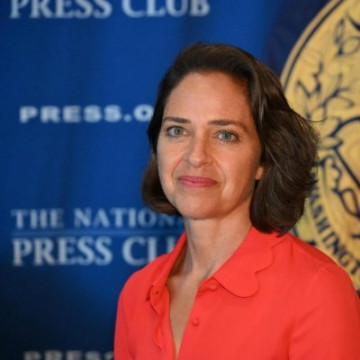
CEO and Chairman
Marly Hornik leads RealAmerica.Vote as CEO and Chairman, standing at the crossroads of citizenship and conscience. An educator by craft and a strategist by instinct, she has become a rally point for Americans who believe liberty is not inherited automatically, but defended deliberately.
She has worked on the front lines of election reform in New York and on the national stage, translating public frustration into disciplined action and measurable oversight. From her leadership as Executive Director of New York Citizens Audit to her role as CEO and Co-Founder of United Sovereign Americans, Hornik has helped build movements that refuse to confuse “trust” with “verification.”
Her work is powered by an unglamorous virtue that changes history: persistence. Thousands of volunteers have answered her call, not because she promises easy victories, but because she insists on something better than slogans—accountability. Where others accept the fog, she demands clarity. Where institutions drift, she calls citizens back to duty.
In an era that rewards noise, Marly Hornik makes a different wager: that truth still matters, and free people still have the will to secure it.