


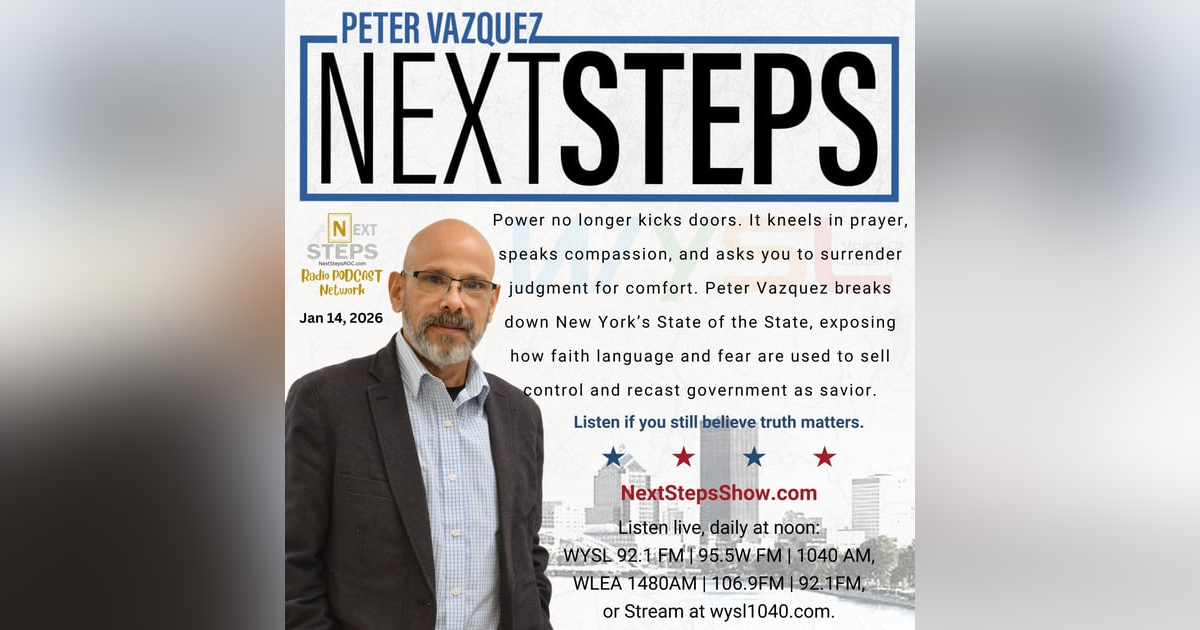

Compassion Becomes Control exposes how modern power advances through persuasion rather than force. Peter Vazquez dissects New York’s State of the State, revealing how faith language, moral framing, and fear are used to legitimize collectivism, expand surveillance, and shift responsibility from families to government. When compassion replaces limits and obedience is sold as kindness, liberty erodes quietly unless citizens discern, speak, and act.


Power no longer kicks down doors. It kneels in prayer, smiles with compassion, and asks you to surrender judgment for comfort. Peter Vazquez dissects New York’s State of the State, exposing how faith language, fear, and collectivism are fused to sell control, soften limits, and recast government as savior. When liberty is reframed as selfish and obedience as love, the cost is paid by families, faith, and freedom.
Promote your brand on the Next Steps Show, airing on WYSL1040.com's AM 1040, FM 92.1, and FM 95.5 West stations. Discover more at nextstepsroc.com/advertise-with-us or dial (585) 346-3000 to get in touch with the WYSL team.
Have you ever dreamt of sharing your unique voice, stories, or expertise with the world through a podcast? Perhaps you're bubbling with ideas but uncertain about where to begin? The journey from idea to launch can be daunting, but that's where we come in. Dive Into the World of Podcasting with Next Steps Radio PODCAST Network! Visit NextStepsRoc.com or call Peter at (585) 880-7580.

Peter Vazquez opens by warning that modern power no longer advances through force but through persuasion. Compassion is increasingly used to soften limits, reposition obedience as kindness, and transfer personal responsibility to the state.
Using New York’s State of the State address as a case study, Vazquez examines how political authority is framed as moral authority. He highlights the use of religious invocations and emotionally calibrated language to establish legitimacy while redirecting faith toward government-centered solutions.
Scripture is used as a lens to distinguish faith from political theater. Vazquez argues that prayer meant to guide conscience becomes manipulation when repurposed to justify policy, blur accountability, or silence dissent.
The address’s emphasis on collectivism, shared journeys, and government as protector is contrasted with the principles of individual responsibility, family authority, and voluntary civil society. Vazquez warns that collectivist language dissolves agency and replaces stewardship with dependency.
Economic claims, crime statistics, and affordability narratives are challenged as selective storytelling designed to cultivate trust without verification. Vazquez questions why increased surveillance and regulation expand even as leaders declare safety and stability.
Callers reinforce concerns over gun control, media narrative control, erosion of constitutional limits, and the growing gap between political messaging and lived reality.
The program concludes by returning to first principles. Compassion without limits becomes control. Authority without accountability breeds quiet tyranny. Liberty survives only where citizens discern, speak, vote, and refuse to trade responsibility for comfort.
End of cleaned transcript.