

 iHeartRadio
 Apple Podcasts
 Spotify
 TuneIn
 Podchaser
 Castro
 Amazon Music
 PlayerFM
 RSS Feed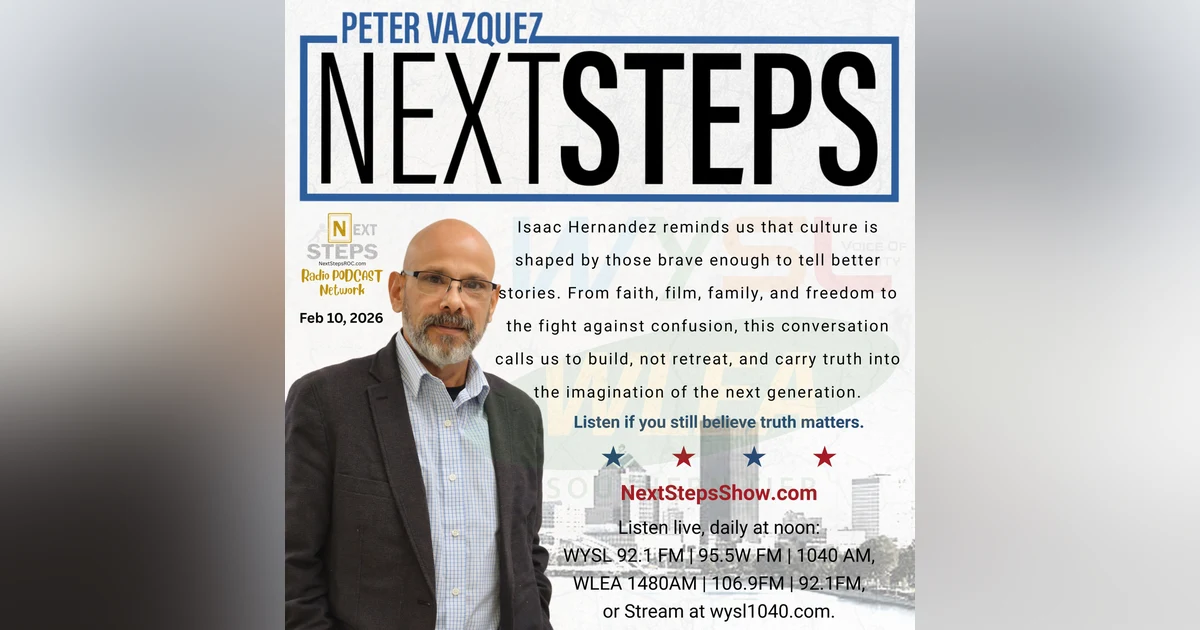

Christian Storytelling is more than a conversation about movies; it is a call to reclaim the imagination before culture teaches the next generation to forget what truth sounds like. Peter Vazquez speaks with Isaac Hernandez, founder of Faith on Film TV, about the work of building cultural infrastructure in a world where screens have become classrooms, stages have become pulpits, and entertainment often shapes the soul before parents, pastors, or teachers can reach it.
Isaac’s story begins as an eleven-year-old boy walking into a television studio near Hollywood and feeling something inside him awaken. What first looked like fascination later became calling. That calling led him through media, television, Christian broadcasting, and eventually into a platform built to spotlight filmmakers, actors, writers, and creators who are telling stories rooted in faith.
The conversation moves through faith, family, immigration, assimilation, education, media influence, and the responsibility Christians have to create rather than merely complain. Isaac speaks openly about being born in Mexico, coming to America legally, honoring his heritage, and embracing the discipline of assimilation without surrendering his identity. He reminds listeners that culture is a gift, but it must never become an idol. For believers, Christianity must stand above tribe, politics, nationality, and trend.
Callers add urgency to the discussion, warning about lawlessness, public education failures, cultural confusion, and a generation being shaped by shallow content and constant distraction. Yet the hour does not sink into despair. It points toward action. Faith on Film TV exists because faith-based creators often lack the promotion and access given to larger secular projects. Isaac’s mission is to give those voices a platform and remind audiences that entertainment can be excellent, meaningful, and spiritually grounded.
Christian Storytelling: Culture - It drifts.
Quietly. Politely. Smoothly packaged. Professionally marketed. Delivered through screens, soundtracks, schoolrooms, halftime shows, streaming platforms, and the endless little windows we hold in our hands like sacred objects. The old village square has become a glowing rectangle, and whoever controls the story controls the imagination of the next generation.
That is where this conversation begins. Not with outrage for outrage’s sake. There is already enough of that cheap merchandise lying around. This begins with a deeper question: what happens when people of faith stop building the places where stories are told?
Isaac Hernandez, founder of Faith on Film TV, understands that question because he has lived inside it. His story starts not in a boardroom, not with a marketing campaign, not with a committee pretending to discover courage, but with an eleven-year-old boy walking into a television studio near Hollywood. Lights. Cameras. Headsets. Movement. Purpose.
Something in him woke up. At the time, he thought it was excitement. Later, he came to recognize it as calling. That calling carried him from childhood curiosity into the world of media, television, and faith-based storytelling. It led him behind cameras, into networks, across platforms, and eventually into the creation of a show designed to give Christian filmmakers, actors, writers, and artists something they often lack: a place to be seen.
- Not because they are celebrities.
- Not because they have the largest budgets.
- Not because they fit the industry’s preferred mold.
- Because they are carrying stories that matter.
Faith on Film TV was born out of a simple but powerful conviction: stories rooted in truth should not be hidden in the corner while culture is handed over to confusion, cynicism, and noise. Isaac did not set out merely to complain about Hollywood. He stepped into the harder work of building an alternative. As usual, building is far less glamorous than complaining, which is why so few people bother.
The conversation moved from film to family, from immigration to assimilation, from media to education, from entertainment to spiritual responsibility. It touched the raw nerve of what so many Americans feel but struggle to name: the country is not just fighting over politics. It is fighting over meaning.
Isaac spoke as a Mexican-born American who came legally, worked hard, assimilated, honored his heritage, and embraced the promise of this country without demanding that the country bend around him. His story is not one of resentment. It is one of gratitude, discipline, and faith. His father, even after a devastating injury, rejected dependency as a permanent identity. Help was a bridge, not a destination.
That distinction matters. Because a culture that teaches people to remain victims will always fear people who choose responsibility. A nation built on liberty cannot survive if its people are trained to confuse compassion with control, identity with grievance, and culture with immunity from truth.
Caller Luis Martinez sharpened that point with the clarity of lived experience. As a naturalized citizen who respected the laws of Mexico while working across the border, he reminded listeners that borders, order, and law are not acts of hatred. They are the basic architecture of civilization. Without them, the house falls. And when the house falls, it is usually the vulnerable who get crushed first, while the powerful relocate and write editorials about empathy.
The discussion of assimilation was not a rejection of heritage. It was a defense of unity. There is beauty in culture, language, food, music, and memory. But culture cannot become an idol. For the Christian, faith must sit above tribe, above politics, above nationality, above popularity, above whatever trend is being sold as liberation this week.
That truth became especially sharp in the conversation around entertainment and public spectacle. Bad Bunny, the Super Bowl, and the wider cultural debate were not treated simply as celebrity gossip. The deeper issue was the message beneath the performance. What are we celebrating? What are we normalizing? What are we asking children to admire?
Isaac made the essential point: culture is not neutral. Entertainment is not harmless simply because it is entertaining. The question is not whether people need stories, music, films, or laughter. Of course they do. Human beings were not made to live on lectures alone. Even the most serious among us needs beauty, imagination, and joy. But the real question is what kind of entertainment forms the soul.
There is entertainment that lifts the eyes. There is entertainment that numbs the conscience. There is entertainment that reminds people they were made for something higher. There is entertainment that teaches them to crawl while calling it freedom.
That is why Faith on Film TV matters. It is not just a show about movies. It is a small act of cultural resistance. It is a platform built to say that excellence and faith do belong together.
Christian creatives do not need to apologize for believing in truth. They need to build better, write stronger, film sharper, and tell stories with enough beauty and courage that the world has to pay attention.
The conversation also moved into education, ignorance, and the quiet disaster of a generation raised by algorithms. Caller Keith warned about a country drifting into stupidity, not because children lack potential, but because too many institutions have abandoned formation. Isaac pointed to the screens, the phones, the shallow content, the endless appetite for nonsense. He described the discouraging reality of posting something meaningful and watching it receive little attention, then posting something foolish and watching it explode.
That is not merely a social media problem. That is a spiritual diagnosis.
A people trained to love distraction will struggle to recognize wisdom. A people entertained into numbness will not notice when their inheritance is being sold. A people who can no longer sit still long enough to learn will eventually be governed by those who prefer them that way.
Still, the conversation did not end in despair. That is important. Despair is easy. It requires no discipline and flatters the ego by pretending cynicism is intelligence. Hope is harder. Hope builds.
Isaac’s work points toward that harder hope.
He has interviewed filmmakers from around the world, including voices from places where sharing the gospel can cost far more than reputation. He described a global community of Christian creators united not by nationality, skin color, or politics, but by the culture of Christ. From America to Asia, from the Middle East to Europe, from small-budget creators to major actors and directors, the mission remains the same: create good content that glorifies God and offers people something better than confusion.
That is the emotional center of the conversation.
The battle for culture is not just fought in elections, courtrooms, classrooms, or legislatures. It is fought in the imagination. It is fought in what children laugh at, what families watch, what artists build, what platforms promote, and what believers are willing to support before they complain that nobody is representing them.
Truth does not lose because it is weak. Truth loses ground when people who know it stop carrying it into the public square.
This hour is a reminder that faith must become visible again. Not obnoxious. Not lazy. Not cheaply produced and excused under the banner of “good intentions.” Visible with excellence. Visible with courage. Visible with craftsmanship. Visible with love. Visible with backbone.
Because the world is not waiting for another lecture. It is waiting for stories strong enough to awaken what has been buried. A boy once walked into a television studio and discovered a calling. Decades later, Isaac Hernandez is still answering it. And through Faith on Film TV, he is helping others answer theirs.
The next generation will inherit a story. The only question is who will be brave enough to tell it.
Promote your brand on the Next Steps Show, airing on WYSL1040.com's AM 1040, FM 92.1, and FM 95.5 West stations. Discover more at nextstepsroc.com/advertise-with-us or dial (585) 346-3000 to get in touch with the WYSL team.
Have you ever dreamt of sharing your unique voice, stories, or expertise with the world through a podcast? Perhaps you're bubbling with ideas but uncertain about where to begin? The journey from idea to launch can be daunting, but that's where we come in. Dive Into the World of Podcasting with Next Steps Radio PODCAST Network! Visit NextStepsRoc.com or call Peter at (585) 880-7580.

Sponsor Message: This podcast is brought to you by Open Door Mission, restoring hope and changing lives. OpenDoorMission.com.
Show Intro: Mira la izquierda, mira la derecha, ¿qué ves? ¿Dónde estás? In a world that seems to change daily, what will you do next? Welcome to The Next Steps Show with Peter Vazquez, a starting point for discussion y un poco de dirección.
Peter Vazquez: Welcome back, ladies and gentlemen. Mira, soy Jose Peter Vazquez, honored to have a whole another lunchtime with you.
Mira, check this out. Tú sabes como yo digo: words matter. Palabras matter, ladies and gentlemen. Culture does not drift toward truth by accident. When those who believe stop building the systems that tell the stories, they do not create neutrality. They surrender a generation’s imagination to whoever shows up next.
We know this. Truth never loses by debate. It loses when those who hold it abandon the systems that shape what a generation sees, believes, and defends.
The lines are open today: 585-346-3000, or toll free at 866-552-1009.
You have to pull out your Spanish-English dictionary for that, right? Just call me Bad Bunny. You are all going español. I am just kidding.
Ladies and gentlemen, we are going to move from a conversation we had just a few weeks ago, on January 16, with Abraham Hernandez, right here from our own backyard. If you remember, we were talking about faith on film. What a concept, because that is not something we see very often these days. We see everything else.
Today we are going to move from the diagnosis to the design. We are pulling back the curtain on how stories are funded, filtered, and formed, why faith-based voices are sidelined, and what it takes to build cultural infrastructure that lasts.
They are not just coming after your wallets. They are coming after what you believe, what your kids believe, and the imagination of the next generation.
I am honored today, and humbled actually, to be joined by a gentleman who has been doing this work for as long as he can remember: Isaac Hernandez, founder of Faith on Film TV. Bienvenido to The Next Steps Show, and muchas gracias for your time today.
Isaac Hernandez: I am so excited to be on with you. It sounds like you have a really great show, and I love your use of Spanglish. I think that is so cool.
Peter Vazquez: Listen, I do not think I know any other Spanish, to be honest. No, I am just kidding. I do that because, really, is that not what most of our third- and fourth-generation little Latinos speak these days?
Isaac Hernandez: Absolutely.
Peter Vazquez: I do not have an agenda today, by the way. I do not have any notes here on what I am going to talk about. You and I are just going to have a conversation and see where it goes.
Isaac Hernandez: That is exactly the way I like to structure my show. Although I keep notes, I joke with Bob Savage, the king of the castle there, and Bob D’Angelo, our guy who makes sure that things happen. You spoke to him earlier. I tell them I do all this show prep, and I do not know why, because my notes go untouched. I like to have conversations.
Peter Vazquez: Isaac, share with our listeners who you are. They heard from Abraham back on January 16. It was a great conversation. He talked a lot about the diagnosis, what is happening, and why the work we do today matters. But Isaac, let us start with what led you individually to do what you are doing. What happened in your life? What next steps did you have to take to create this Faith on Film concept?
Isaac Hernandez: I will go way back to when I was a kid because that really is what started my journey into the world of media.
Peter Vazquez: A couple decades, you are saying, right?
Isaac Hernandez: Yes, sure. When I was eleven years old, my dad and I were in Hollywood. We lived close to Hollywood, and we were driving around seeing fun stuff to do. We saw a big line going into a TV studio. My dad said, “Let us go see what that is about.”
We parked, got in line, and went inside this TV studio. I am telling you, something in me just jumped and said, “This is what you want to do in life.”
I do not want to make this too spiritual, but in reality, it was not until later that I realized that was actually God saying, “This is your purpose.” At the time, I just thought it was cool: the lights, the people on headsets, everyone talking to each other, producing a show. But later I honestly realized that God was saying, “This is your purpose, and this is what you are to do.”
So I set myself up to do that from the time I was eleven. I started doing little films with my dad’s film camera, the kind you still had to wind up. By the time I became a teenager, I started volunteering at a TV network. Back then it was a small television network, but later it literally became the largest television network in the world, Trinity Broadcasting Network.
I volunteered for them, then eventually got hired, and as they say, the rest is history.
Peter Vazquez: It appears like it is a great history. So you grew up in Hollywood. You are Latino, right?
Isaac Hernandez: No, soy Mexicano. I am Mexican. I was actually born in Tijuana. But we moved to the United States. And guess what? We did it legally.
Peter Vazquez: I was going to ask you. You are in California. Being Mexican in California, according to your governor, means you should be petrified.
Here in Rochester, we have leaders in the Hispanic community, some of the top leaders who run some of the top organizations and nonprofits, very progressive leaning, who use every microphone they have to convince the Latino community in this area that we are being hunted. They use that word. “We are being hunted.”
What are you talking about?
So you are Mexican, you were born in Mexico, you live in California, and you are not afraid of ICE?
Isaac Hernandez: Not at all. You know who should be afraid of ICE? Those who are doing illegal things.
I was born in Mexico, but I was really raised in California, then moved to Texas. I live in Texas now, by the way. I was raised adhering to the culture of America. I love my culture. I love being Mexican. I love eating Mexican food. Although I have to admit, I am married to a Puerto Rican, and I now really enjoy Puerto Rican food.
Nonetheless, I am Mexican, but I assimilated into the American culture. I did not go to a school that continued to teach me in Spanish. I went to a school where I had to learn English very quickly or else I would be out of the picture.
So I have no reason to fear that somebody is going to pick me up and throw me back to Mexico.
Peter Vazquez: Then none of that narrative fits you. Some of the other mantra we hear from your governor, our governor, and governors throughout the country is that people like you and me, but especially you because you are Mexican, must need government help. The government must provide everything for you because you came to this nation with that intent, and you are too afraid to say it.
None of that narrative fits you.
Isaac Hernandez: None of it. I think a lot of it is the way my parents raised us. We were raised to work. We were going to earn our keep.
My dad got very seriously hurt when I was around fourteen or fifteen. He ended up with a broken back. They literally took three discs and two vertebrae out of his spine and replaced them with a piece of plastic.
Because of that, we actually did have to go on welfare. He hated it. The minute he was able to work, even though he was technically disabled, he did it because he was not going to stay on welfare. He was going to take care of his family.
That is what we grew up with. We were not going to be a burden to anybody. We were going to do what we needed to do to succeed.
Peter Vazquez: As it should be. That is the American dream. I think that is why I find it so odd when people fight against it.
Como un Latino, un puertorriqueño, I do not need government help. Get out of my way. Let me help when we can. Your family came here legally. You used the system when you needed it, which is what it is for, for American citizens doing the right things who just need a little help. There is nothing wrong with that.
Sir, I am going to quote you. You said, I believe on your website, that you recall waking up at 3 a.m. hearing in your head: “Do a show in which you interview people working in the faith film industry.” That inspired you.
You talked a little bit about that. What happens when Christian creatives move from apologetic to excellence? What kind of pushback do we see? How are you accepted in the industry? Can excellence be a thing for Christian creators?
Isaac Hernandez: Let me go back to what you said about 3 a.m. I really do not know why God does this, and He has done it with me a lot. Directions that He gives me, He gives them to me at 3 a.m. I think, “Why are You waking me up at 3 a.m.? I would like to get my sleep.”
But I think it is because that is when I am least interrupted by anything.
I believe I started the show because I saw that faith-based movies and Christian movies just do not get the promotion or marketing they need to succeed. They do not have the money. The big networks, certainly the non-Christian networks, are not going to have them on to promote their movie.
Even the large Christian networks were not doing it either, because they also wanted the big superstars to come on and talk about their movies. If you are not Kevin Sorbo, Dean Cain, or one of those bigger names, they are not going to bring you on.
I think God needed somebody who would help promote smaller producers and smaller movies that just do not get help. That is why I started the show.
I had never done that before. I had been behind the camera. I was a television director. I had never been the host of a show. I thought, “Okay, I will do this.”
This is important: I posted it on Facebook that I was going to do this because I needed to be held accountable. If I did not do that, I probably would have talked myself out of it. But by posting it, I made it public. Now I had to do it.
Within about thirty minutes, I got a comment from a guy who had a streaming platform with about a million subscribers. He said, “Hey, Isaac, can I carry your show on our network?”
I said, “It is not going to be a big show. It is just going to be more of a video podcast.”
He said, “I do not care. It is you, and that is what matters to me.”
That carried some weight for me. I felt like I had to come through.
Then, within another thirty minutes, I got another comment from a guy who had worked for the same media company as me, Olympusat. He was running a network on DirecTV called Uplift TV. He said, “Wait a minute. You work for us. Why are we not getting your show?”
I said, “It is not like it is a big show.”
He said, “You let me decide that.”
So I literally launched the show on a network that was on satellite in over 19 million homes. What a way to start.
Peter Vazquez: Ladies and gentlemen, we have Isaac Hernandez, founder of Faith on Film TV. This show expanded from a YouTube channel to over twenty-eight networks. God is good. Do not go anywhere. Jose Peter Vazquez right here on WYSL and WLEA. Know where to dial, and give us a call.
Sponsor Message: Picture this: a mother of three finally turning the key to her first real home. A struggling neighbor no longer sleeping in their car. A child with a warm bed and a full night’s sleep. That is the impact of your support.
At Keuka Housing Council, we are not asking for charity. We are building change. Whether you can give five dollars or five thousand dollars, every gift drives real results. Go to KeukaHousingCouncil.org or call Peter Vazquez at 315-536-8707. Together, we are taking a step toward independence, one family at a time.
Sponsor Message: The Rochester Auto Show, Friday, February 27 through Sunday, March 1 at the Convention Center. Discount tickets at TOPS Markets. For details, visit TheRochesterAutoShow.com. Driving tomorrow, the future starts here.
Sponsor Message: The youth of our city are in a new crisis. Criminal justice reform has created the consequences of no consequences and generated a whole new generation of 12- to 17-year-old kids committing serious crimes. Never before have we had this level of youthful offenders.
But 90 percent of these kids are just trying to do the right thing and need a safe sanctuary to retreat to. That is Rochester Youth for Christ. You can be part of this solution by giving generously and regularly at YFCRochester.org/donate.
Station ID: Peter Vazquez and The Next Steps Show on the Voice of Liberty.
Peter Vazquez: Mira, the things we do in this world should be, and always will be, a family affair.
Welcome back. First Corinthians 14:33 says, “For God is not the author of confusion, but of peace, as in all churches of the saints.”
Ladies and gentlemen, we have Isaac Hernandez, founder of Faith on Film TV.
Isaac, I appreciate you taking the time, and we have a caller on the line. It is Señor Luis Martinez. Brother Martinez, welcome.
Luis Martinez: Mr. Fernandez, welcome to The Next Steps Show. I have two quick points to make. I am driving around, and I stopped to do this because I want to let the audience hear this.
Eleven years ago, I was working in Mexico, installing the payroll system in the Corona Modelo brewing company in Nava, Mexico. I want to emphasize this: literally, I was going back and forth across the Rio Bravo at Eagle Pass every morning.
Every morning, I got in the car, actually with a chauffeur because I was not going to drive there, and they took me from Eagle Pass to Piedras Negras. I would get out of the car at the customs house on the Mexican side of the border. I would present all my paperwork. They saw me yesterday, last week, last month. They knew who I was.
I presented all my paperwork respectfully, greeted everybody there, got back in the car, and went to work at the factory in Nava where they make the beer from Modelo and Corona that comes to the United States.
That was an international deal. I did this for months. Every day, I respected the Mexican population, the Mexican government, and Mexican law and order. I presented myself as a foreigner in Mexico to do my work, then came back. We finished that job in 2016.
The point is that I respected all the laws, and I expect everyone else to respect the laws. By the way, I am a naturalized U.S. citizen. I remember when I used to carry a green card. It was required by federal law that I carry a green card as long as I had one, until I became a citizen.
The other topic is assimilation. The gentleman mentioned assimilation as opposed to multiculturalism. Multiculturalism is divisive. It sounds very sweet, but it is very divisive. People live in enclaves. They live in tribal units where they do not allow American law enforcement and do not want to allow American traditions.
I am against that. I am against multiculturalism. I am in favor of assimilation. The gentleman has provided us with an example.
Those are secular topics. Now let us go to the Christian topics.
Peter Vazquez: Luis, do not hang up. Isaac, do you want to respond?
Isaac Hernandez: I think you mentioned assimilation versus multiculturalism when it comes to our cultures, but I think a problem we are seeing right now, even with what happened at the Super Bowl, is that we also have to put our Christianity above our culture.
The problem is people are putting culture above their Christianity. That is why everybody was thrilled with what happened at the Super Bowl. Culturally, it was absolutely beautiful. I loved it. I did not see it live. I saw it later, and it was great. But the message it was sending was against my Christian culture, if you will. So I have to put that above my Mexican culture.
Luis Martinez: That was a perfect illustration of what happened during that halftime show by so-called Bad Bunny. Benito has done some terrible things, both in the lyrics of the songs he sang, which are absolutely filthy, and also by blaming the United States, specifically the president, for keeping law and order.
This is the nation that has been more gracious to people around the world than any country in existence. Instead of being grateful that immigrants like me and Mr. Fernandez have been enjoying the grace of the United States, the American people, especially American Christian people, are the most generous people in world history. Irrefutably and irrevocably, the most generous people in world history.
Here we have somebody whose cultural aspects are, to put it mildly, despicable. He is heralded now as some kind of hero. What he represents is awful: being against the United States, the most generous nation in the world, and in favor of illegal alien activity and cultural degradation.
Peter Vazquez: Luis, you have heard me mention this before. Isaac, I have to say that the left, the progressives, the Democrats, have one of the most dynamic marketing plans out there. Am I wrong? They have half the world convinced that we are all racist because we do not support Bad Bunny, a Puerto Rican.
They understood what they were doing.
Luis Martinez: There are Puerto Ricans included who are exposing what this guy has done with his culture and his music. There is a lot of music I will not listen to, and that includes what he writes. I do not care where he is from.
The halftime show was just perpetrating some really awful stuff that he was allowed to get away with because he did it in Spanish. He could not have sung those songs in English because he would have been canceled on the spot and maybe even fined under FCC regulations.
Thank you for listening to me. I have spoken more than enough. I appreciate your presence there, Mr. Fernandez.
Isaac Hernandez: Thank you. I appreciate the call.
Peter Vazquez: Amigos y amigas, Luis Martinez, mi amigo from Cuba. I am just messing around. Thank you, Luis.
Isaac, how was that whole thing being received in California? What were you seeing as far as Bad Bunny and this whole alternative show? A lot of people tried to say it was a bunch of white people separating from Puerto Ricans and all this other stuff.
Isaac Hernandez: I did not even know who he was, to be honest with you. I am around sixty-seven now, so that is not my type of music. I grew up in the church, so my type of music is more faith music.
I am thinking this might have been a setup. First, they put out all this promotional stuff that Bad Bunny was going to be on, and they started putting out pictures of him in dresses and all this stuff to create that war between the two sides. It created the war, and then he did not even do that. He came out dressed like a guy.
Yes, he was speaking in Spanish, which was kind of weird. I understand Spanish, and I could not even understand him.
Peter Vazquez: I could not either. And listen, last year’s halftime show, I could not understand the guy, and apparently he was speaking English.
Ladies and gentlemen, on the telephone I have Isaac Hernandez, founder of Faith on Film TV. FaithOnFilmTV.com. We are going to break. While we are on break, let us not forget our sponsors, Youth for Christ Rochester, YFCRochester.org. Thank you for the work you do saving our young people. We will be right back.
Station ID: Peter Vazquez and The Next Steps Show on the Voice of Liberty.
Peter Vazquez: Let me leave you something to ponder. Proverbs 22:29 says, “Do you see a man who excels in his work? He will stand before kings; he will not stand before unknown men.”
Welcome back to The Next Steps Show, ladies and gentlemen. I have Isaac Hernandez, founder of Faith on Film TV. That is FaithOnFilmTV.com.
Isaac, thank you again for spending this hour with me today.
Isaac Hernandez: It is my pleasure completely.
Peter Vazquez: Ladies and gentlemen, do not forget, the lines are open: 585-346-3000, or toll free at 866-552-1009.
Isaac, streaming services like YouTube, where you started, dominate the entertainment industry. As I understand it, 83 percent of U.S. adults use a streaming platform, while only 36 percent subscribe to cable or satellite TV, not to mention the cost.
This shift opens avenues for a niche like faith-based television. But can a faith-based show truly compete in an era of TikTok, or must it?
Isaac Hernandez: Obviously it can in some way. But here is what I have noticed, and it is a little disheartening to me. When I post something I will call deep, some spiritual thought or something like that, I get a few likes and maybe a couple comments.
Then I post something really stupid, like one time I fell, and I happened to be taping myself. I do not know why I was doing that. I posted that, and I got thousands of views, comments, and likes.
That is disheartening because I am glad those platforms exist. They give us the opportunity to get out there. But I am disappointed that the audience using these platforms is more interested in nonsense than in the good stuff.
Peter Vazquez: Does the entertainment industry, radio included, or anyone who influences another person, have a responsibility to portray things honestly and offer hope, especially as it pertains to mental health?
Isaac Hernandez: Absolutely. That is what Faith on Film is about. It promotes movies, music, and books that give hope and portray a lifestyle that would be helpful to people.
A lot of movies are being made, but most people do not even know about them. That is why we are there. That is why we exist.
I am grateful for YouTube, Rumble, and places like that where you can get Faith on Film and other content. I was doing this even before COVID, before some of the big network people started doing shows from home.
There are many shows out there now, though I do not want to say they are doing what I do. Often, people still have the mentality of wanting to preach and teach. A lot of shows on streaming are like that, whereas ours is about entertainment.
I know some Christians will say, “We are not supposed to want entertainment. We are supposed to want the Word.” But we are humans, and we need entertainment. The question is: what entertainment are we going to consume?
Those same Christians who say that often go to secular movies and watch secular television shows that are not good for their souls.
Peter Vazquez: That is interesting, because that is 100 percent true.
Keith, thank you for calling The Next Steps Show.
Keith: I called in, and I was thinking about what my comment would be. This does not have to do with any one group by any means, but I will bring in Hispanics since the three of you have been talking, including Mr. Martinez.
I was trying to think of the greatest danger to our country, and that is the I-word: ignorance. The three of you speaking here represent Hispanics in general. The guest said he is of Mexican background and married a Puerto Rican lady. The three of you, including Mr. Martinez, are the I-word of intelligent.
But I am concerned about younger generations who are not being taught. Here is a fast example: in a recent survey of schoolchildren in Georgia, only 5 percent were up to speed on their math test.
Even more than intolerance, I believe ignorance is going to doom our country. We have always been ahead, like in the space race, because we had intelligent people. Even when the Russians beat us putting up Sputnik, Americans quickly came from behind and caught up.
But I am concerned that with overall ignorance, the United States of America, the best country in the world, celebrating our 250th anniversary, will not remain the good old USA if we have a population that is not keeping up with past generations of Americans.
Peter Vazquez: Let me add to that, Isaac, before you respond. In 2024, 5.6 percent of U.S. adults, or 14 million people, experienced serious mental health issues. Nearly 9.6 percent of adults with mental health illness lacked insurance.
Mental health conditions continue to rise as we move through media. I have had people from MRCTV, investigative reporters and others, who have proven that the media has become a selector of what we see and watch.
Isaac Hernandez: I do not know a whole lot about mental health, but I do know a lot about ignorance, which the caller brought up. I blame that on media. I blame that on the media being put out there and the media everybody is consuming.
I hate seeing my grandkids literally looking at their phones for half the day. Some of what they are watching is stupid stuff, really silly, stupid stuff. Yes, that is making them ignorant. Is it creating mental health problems? I do not know. I do not know enough about that side of things.
Keith: The problem is these government propaganda public schools. I agree with you about the media, but our kids are not being taught. It is the teachers’ unions, who lean left and even communist now, who are not teaching our kids. They are not even having adequate seat time, where students sit down and simply learn.
If children go to school and are not being taught by teachers who are against us, even as a fifth column against the good old USA, then we have a serious problem. We have people in our country and teachers’ unions who really hate our country.
Unless our children are adequately taught, that is why they should even be homeschooled if financially possible, our young people today are coming out undereducated. They do not have the hope for education that past American generations had. That will be very telling in our country’s future.
Peter Vazquez: Keith, I appreciate the call. Isaac, do you want to respond?
Isaac Hernandez: I think he is right. Our schools are just not teaching anymore. They are allowing these kids to have their phones half the time. These kids are probably on their phones watching something else instead of learning, or at least instead of learning what they are supposed to be learning.
Peter Vazquez: Absolutely.
Looking at FaithOnFilmTV.com, we have Isaac Hernandez, founder of Faith on Film TV. I wanted to look more into the organization and the things you do to truly influence and shift culture, to offset some of the things Keith said he is seeing.
When you look at faith-based media and how it pushes back against cultural decay by restoring stories rooted in God, how are you able to grow so fast in an environment that would choose what Bad Bunny is selling before it would choose what the Bible is selling?
Isaac Hernandez: I know it was a calling on my life. I know what I am doing is in obedience to that calling. When you are obedient to what God calls you to do, He makes sure the growth and success happen.
I have not gone after any of the outlets I am on. As I mentioned earlier, the first big network I was on came to me. They said, “You work for us. Why are we not getting the show?”
Beyond that, people keep coming to me saying, “I have this network, this station, or this streaming platform. Can I have your show?”
To me, that is God saying, “I am going to make sure you get out there as widely as possible, because that is how I make sure these filmmakers get exposure.”
Peter Vazquez: Isaac Hernandez, ladies and gentlemen. FaithOnFilmTV.com. We will be right back after we pay a couple bills right here on WYSL and WLEA. Check out WYSL1040.com or NextStepsShow.com. No te vayas.
Music Break: [Music break. Lyrics omitted.]
Sponsor Message: At Keuka Housing Council, we offer real help when it matters most. Whether you are facing foreclosure, stuck in an unsafe mobile home, need rental counseling, or critical repairs, we guide families through stability and homeownership. Visit KeukaHousingCouncil.org and take your step forward toward independence.
Sponsor Message: Cornhole at a pickleball tournament? Yes. Register for Youth for Christ’s Picklepalooza 2026, Saturday, April 25, 3 to 7 p.m. at Dinkers in East Rochester. Beginners and all levels welcome. Not a pickleballer? Join our cornhole tourney. Fabulous pizza and treats from Perri’s. Pickleball is $95 per person, $125 per team. Cornhole is $40 per person, $75 per team. Saturday, April 25, 3 to 7 p.m. at Dinkers in East Rochester. Register today at YFCRochester.org/pickle.
Station ID: Peter Vazquez and The Next Steps Show on the Voice of Liberty.
Peter Vazquez: Mira, ladies and gentlemen, welcome back. Aquí con Isaac Hernandez, founder of FaithOnFilmTV.com. The lines are open.
A quick shout-out to our sponsors, Youth for Christ Rochester, YFCRochester.org. It is interesting, Isaac, because our sponsor, Youth for Christ, is run by a veteran. They do not receive government funds for the work they do, but they are saving more kids.
I hate to use skin color and racial terms like that, but unfortunately, that is a measurement our society uses at this point. These kids in the urban center, whom politics has said are pretty much victims, have been reached in a different way. He has changed that around almost single-handedly. And you know how he did it? He did it with prayer. Is that not something?
Isaac Hernandez: It is great to know prayer works, is it not?
Peter Vazquez: It does. Talking about prayer working, let us talk about FaithOnFilmTV.com and the kind of lives you are saving there. You have mentioned some of this throughout and dropped some tidbits, but talk to us about the people you have interviewed, their reaction to society, and why it is so important.
Isaac Hernandez: In the beginning, I was mostly interviewing up-and-coming filmmakers, brand-new filmmakers, or people making smaller, very low-budget films that were not theatrical. They went straight to streaming.
Having them on the show has helped them and boosted their exposure. Now some are making slightly bigger films.
We are also interviewing many bigger Hollywood filmmakers and actors. They like coming on the show because we give them an opportunity to share about themselves, instead of only talking about the movie they are in.
Usually people ask, “Did you like doing the movie? Anything interesting happen on set?” On the show, I like to ask, “How did you get started in this? If it is a faith-based movie, what caused you to be involved in a faith-based movie versus a regular secular movie?”
It gives them the opportunity to share more about their lives. I think we are creating an impact on some of these stars and filmmakers, helping them take a look inside and realize, “I did not do this just because it was a money-making film. I did this because I had a message I felt I needed to put out.”
Peter Vazquez: The Chosen, The Passion of the Christ, I Can Only Imagine, all of those were based on stories. Your show, Faith on Film TV, is available on YouTube and your website. Is YouTube the best place for people to go?
Isaac Hernandez: It is on many networks and stations, but if you are not in a place where one of those stations is available, the easiest thing to do is go to YouTube and look up Faith on Film TV. You will see all the shows. I have about 277 shows now.
An important thing to do is subscribe and hit the notification bell. That way, every time I put out a new show, which is every week, you will be notified and can get to it as soon as you can.
No matter where you are, you can watch Faith on Film TV.
Peter Vazquez: Those three pictures I mentioned, The Chosen, The Passion of the Christ, and I Can Only Imagine, have you had any of those directors or movie stars on your show? Those are great, life-changing works.
Isaac Hernandez: Yes. I had the creator and director of The Chosen when they first started doing the series, the very first season. In fact, I think he was my second guest on the show.
I had known him for many years. He had called me because, at the time, I was running a streaming platform called Parables. He had this idea for a series about Jesus and the disciples. He called to see whether we could fund it. Of course, we were just not at that level at the time.
I said, “I wish I could, but we cannot.”
That was great for him because he ended up going to somebody else who was able to fund not only what he wanted, but ten times what he wanted. God knows where things are supposed to be.
I have had him on. I have not had somebody from The Passion because it is very difficult to get Mel Gibson. We are not that big yet.
Peter Vazquez: Yet.
Isaac Hernandez: Yet. You also mentioned I Can Only Imagine. I have had the director. In fact, the show that just came out this past week was with the director, and the show coming out today is with the real guys from I Can Only Imagine 2, the real gentlemen the movie is about. Very good interviews.
Peter Vazquez: Isaac, I am jealous. You can always tell them to join us. People like them, their stories, and the fact that they made it big matter. But when they come on shows like yours and mine, where we are still talking directly to the people where they are, I think that is huge.
Congratulations, Isaac. I love the work you are doing. That is God at work.
Sir, you and your team have interviewed creators from all over the world: the Middle East, Asia, Europe, people who have risked their lives to share the gospel. Can you talk to us about that? Here in the United States, freedom of speech is under attack. I could read off statistics, but why is sharing those voices, even from countries that are often anti-American or anti-what we believe, so important?
Isaac Hernandez: If you put your Christianity above your culture, then around the world we are all from the same culture.
If you are in Uganda, South Africa, or somewhere else, and maybe people say they do not like Americans, if your culture is Christianity, we love each other. We all work together.
I am part of an organization called International Christian Visual Media, ICVM. When we have our conference, people come from China, Japan, and many other countries. We all come together because we have the same mission: to create good content that glorifies the Lord.
By the way, that does not mean a movie has to have an altar call. It just has to tell a story from a biblical perspective.
We all come together as one unit. We are from different countries, but we come together as one culture, and that is the culture of Christ.
Peter Vazquez: When I say God, country, family, and I mean it in that order, that is exactly what I am trying to get people to understand.
Our support for Israel has nothing to do with our government. It has to do with the way the Bible instructs us regarding the nation of Israel. When it comes to the separation of Islam and Christianity, and talking about culture, people need to understand this.
Thank you so much.
We had a discussion about whether there is a different God for Islam and Christianity, the same God through Abraham, then Jesus came, and all that. People are dying trying to have a discussion about God in countries where religion is treated as a “do as I tell you” kind of system, when that is not allowed.
Sir, we are down to the last minute. Can you share with our listeners how they can get ahold of you, how they can get involved, and what I like to call next steps advice, especially for our Latino and Hispanic kids who are being confused between culture and faith?
Isaac Hernandez: The best thing is to go to the website, FaithOnFilmTV.com. There you will see links to all the shows, which will take you to our YouTube channel.
If you want to send me an email, I can be found at Isaac@FaithOnFilmTV.com. I would love to hear from you.
Peter Vazquez: Sir, thank you again for your time. Ladies and gentlemen, Isaac Hernandez. When you are up in April, let me know because I am going to bring you into the studio when you come in, and we can talk in person.
Thank you again.
Ladies and gentlemen, Micah 6:8 says, “He has shown you, O man, what is good; and what does the Lord require of you but to do justly, to love mercy.”
Be a leader. Be a leader. Be a leader.
God bless these United States of America. Do not let a second go by where you are not a voice for libertad.
Show Host
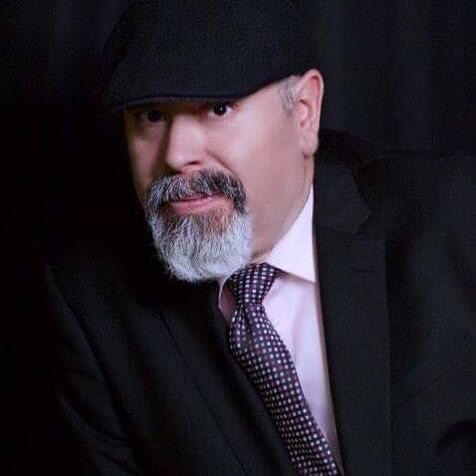
Isaac has a prolific portfolio with over four decades of experience in the Christian entertainment industry which includes directing and producing hundreds of TV shows for the Trinity Broadcasting Network, including their live flagship show Praise the Lord. He also served as a programming executive for the network before leaving to help launch the first faith-based subscription streaming movie platform, Parables TV.
Isaac was also chosen to be the director of PAXtv’s flagship show GREAT DAY AMERICA when the network first launched.
Isaac has Executive Produced 7 independent Faith-Based Feature Films and 2 Faith-Based television reality series.
In 2019, He launched his own TV show, “Faith On Film,” an interview talk program that can be seen on over 28 various platforms and networks worldwide. He is now joined by his co-host Holly McClure.
Currently, Isaac is consulting for several streaming companies, film distributors, and producers as well as producing and directing TV shows.